If the only difference between the salon and iFood was a 23% commission on the value sold, increasing the price by 23% would not preserve the same result. The reason is simple: the commission is applied to the new price, which has already been adjusted. To neutralize a 23% rate, the mathematical increase is approximately 29.87%. An item worth R$50.00 would have to reach around R$64.94 so that, after deducting 23%, there would be R$50.00 left.
This account, however, only solves part of the problem. The correct comparison between the salon, its own menu and the marketplace needs to consider the set of costs for each channel: COGS, packaging, payment rate, sales tax, commission, promotions financed by the store, possible delivery costs and the margin that the business wants to preserve. The final price should not come from a generic percentage applied to the entire menu, but from the real savings of each channel.
Why adding 23% to the price does not compensate for a 23% commission
Imagine a dish sold for R$50.00 in the dining room. If you simply add 23%, the new price will be R$61.50. The 23% commission on R$61.50 is approximately R$14.15. After this discount, you are left with R$47.35, not the R$50.00 you intended to preserve.
The error occurs because the 23% added was calculated on the old price, while the 23% commission is charged on the new price. To correct this, you need to do the so-called gross-up: divide the value you want to preserve by 1 minus the percentage rate.
The formula is: price with gross-up = value you want to preserve / (1 - percentage rate).
In the example, R$50.00 / (1 - 0.23) = R$64.94. Applying 23% on R$64.94, the discount is close to R$14.94 and the remaining amount returns to R$50.00.
Therefore, a rate of 23% corresponds to an adjustment of around 29.87% when it is the only new percentage cost. If the sum of the fees levied on the same base were 26%, the gross-up would be approximately 35.14%. If it were 31%, the adjustment necessary to preserve the same value before these fees would be approximately 44.93%.
These percentages are mathematical demonstrations, not an iFood rate table. The store's effective contract is what must feed the bill.
Before calculating, find out the rate that is really worth for your store
iFood itself guides the partner to consult the contractual data on the Partner Portal. The commission percentage, the transfer plan and the business model can be checked in the account data and in the contract, while the Financial panel allows you to review the entries effectively discounted from orders and transfers.
This is safer than copying a rate found in an old article, video or conversation. Plans, commercial conditions, logistics, payment methods and transfer rules may change, and not every restaurant operates with the same structure. The official iFood rates page also highlights that active values must be checked in the application or on the Partner Portal.
The pricing calculator maintained by iFood starts from the price already charged by the store and incorporates additional channel costs, such as commission, delivery, campaigns and coupons. The useful logic behind this is precisely to separate the base price of the operation from the specific costs of selling through the platform.
The difference between preserving revenue, contribution in reais and percentage margin
The phrase “I want to keep the same margin” can mean different things, and mixing them together often produces wrong prices.
Preserving net revenue before other costs means that, after the commission, the same amount remains as would have come in without that commission. In this case, the simple gross-up resolves when there is only one new percentage rate.
Preserving contribution margin in reais means wanting each sale to continue leaving the same amount to pay fixed costs and generate profit. This also includes COGS, packaging and other variable channel costs.
Preserving the same percentage contribution margin is even more demanding. If the platform adds a relevant commission and other variable costs, maintaining exactly the same percentage of the price as a contribution may require a much higher sales value. For some items, this price may be commercially unviable. In this case, the decision is not just mathematical: it is necessary to review cost, portion, packaging, promotion, product mix or the margin target for that channel.
Formula to preserve the same contribution in reais
To compare channels, a practical way is to first calculate how much contribution margin the item leaves in the reference channel. Then, you find the necessary price on the new channel to preserve that same value.
Use logic: price of the new channel = (costs in reais of the new channel + desired contribution in reais) / (1 - sum of the percentage rates of the new channel).
The costs in reais include items such as COGS, packaging and a delivery allowance paid by the store, if applicable. Percentage rates only include charges that actually apply as a percentage of the same sales base, such as commission, payment rate and sales tax, depending on the fiscal reality of the business.
If two rates use different bases, do not automatically add them together. The calculation must reflect the actual basis of each charge. Likewise, a fee that only appears in part of the requests should not be applied as if it applied to 100% of them; it may be necessary to use a weighted effective rate.
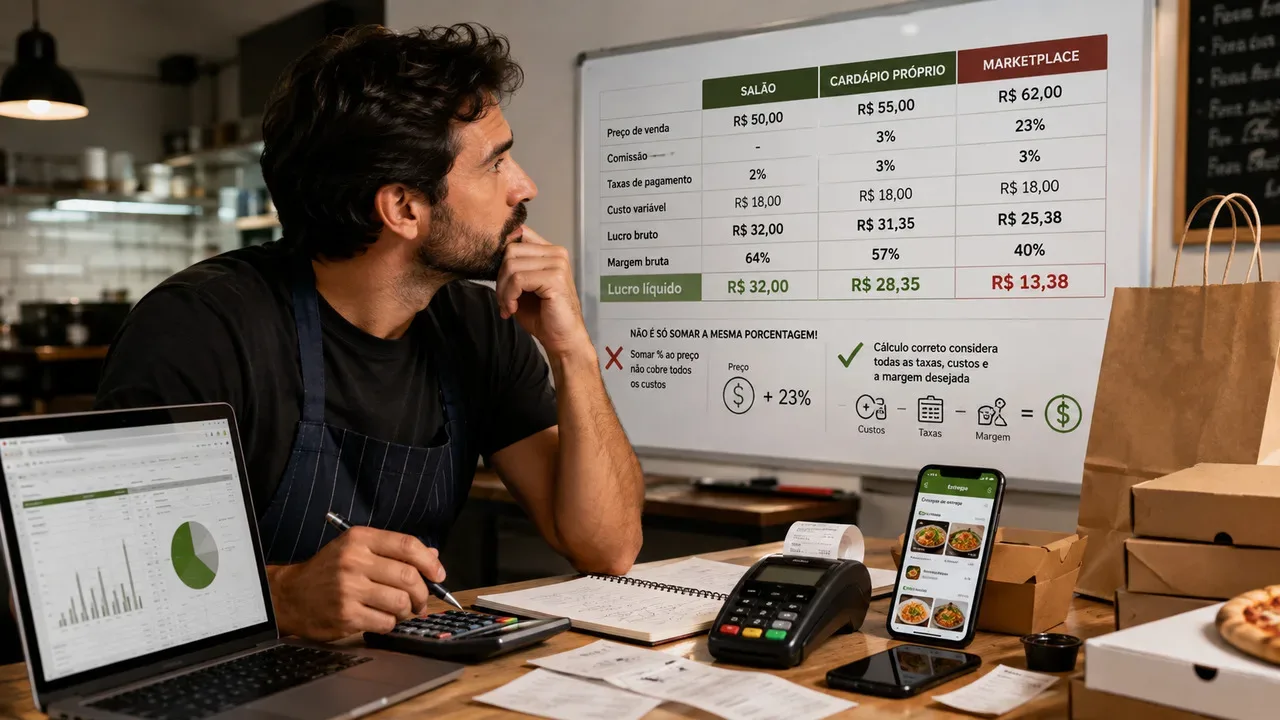
An example comparing salon, own menu and marketplace
Consider a hypothetical example, just to show the method. A dish is sold for R$50.00 in the room and has a COGS of R$18.00. In this channel, assume 2% payment cost and 5% sales tax. The percentage sum is 7%. The contribution margin in reais is R$28.50: R$50.00 minus R$18.00 in COGS and minus R$3.50 in percentage costs.
Now imagine your own menu with the same COGS of R$18.00, plus R$2.00 for packaging, 3% payment and the same 5% tax. To preserve the R$28.50 contribution, the bill is R$48.50 divided by 0.92. The reference price is approximately R$52.72.
On the marketplace, keep the same COGS of R$18.00 and R$2.00 for packaging. To illustrate the effect of commission, use 23% commission, 3% payment and 5% tax, totaling 31% on the same basis in this example. To preserve the same R$28.50 contribution, the calculation is R$48.50 divided by 0.69. The reference price is approximately R$70.29.
This represents around 40.6% more than the R$50.00 for the salon, although the isolated commission in the example is 23%. The rest of the difference comes from packaging and other variable expenses. That’s why asking just “how much is the commission?” it is not enough to decide the price of the application.
The above numbers should not be copied into a real operation. Commission, payment, tax, packaging and logistics need to be replaced with the store's actual values.
Formula for working with a desired percentage margin
When the goal is a percentage contribution margin on the sales price, the formula changes. Consider C as the variable costs in reais per unit or order, T as the sum of the percentage rates that apply to the sale and M as the desired percentage contribution margin.
The calculation is: price = C / (1 - T - M).
If C is R$20.00, the percentage rates add up to 31% and the desired margin is 30%, the denominator will be 0.39. The reference price will be R$51.28. At this price, approximately 31% pay the percentage fees, R$20.00 covers the costs in reais and 30% remains as a contribution.
This formula requires attention to not count the same expense twice. If you have already included a certain fixed expense within the contribution margin target, you should not add it back as a unit cost without a consistent apportionment criterion.
What fields to separate in your pricing spreadsheet by channel
The first field is CMV. It represents the ingredients or goods consumed in that item and should ideally come from an updated technical sheet. If the input cost has changed, the price per channel also needs to be reviewed.
The second is packaging. In the salon it can be zero or very low; in delivery, it may include a pot, lid, bag, seal, napkin and accessories. If packaging is per order and not per item, distribute the cost consistently across the average ticket or average quantity of items, rather than throwing the entire amount across all products.
The third field is tax. Use the effective load applicable to your operation, with accounting guidance where necessary. Different tax regimes should not be treated as if they had the same tax rate per sale.
The fourth is the marketplace commission. This is where the contracted rate that actually affects the operation comes into play. Don't automatically use the standard rate published on a page if your contract states otherwise.
The fifth is payment. Card in the salon, gateway on your own menu and payment within the marketplace may have different costs. If you only charge certain payment methods, calculate an effective rate based on the actual order mix.
The sixth brings together variable promotional and logistical costs. Coupon financed by the store, campaign, discount, subsidized delivery and anticipation of receivables should only be included when they are actually supported by the establishment and in the manner in which they are charged.
The last one is the desired margin. It needs to be defined after variable costs and must leave room to pay rent, payroll, energy, systems, accounting and other fixed costs, in addition to generating the intended result. Sebrae treats the contribution margin precisely as the portion of the price that remains after variable costs and expenses to cover fixed expenses and produce profit.
Monthly fees and fixed costs are not included as if they were commission
A monthly platform fee, rent, administrative salary or software cost should not simply be added to the commission percentage. These expenses do not vary in the same way as a fee charged on each sale.
You can cover them by the total contribution margin of the operation or make a managerial apportionment per order, as long as the criteria are consistent. For example, if you decide to allocate a monthly expense over expected order volume, revise the calculation when actual volume changes. Otherwise, a weak month could leave the apportionment underestimated and a very strong month could make you charge too much cost on each order.
Do not apply a single adjustment to the entire menu without testing item by item
Two dishes sold for the same price can have completely different COGS. One can use cheap packaging and bear the commission better; another may have expensive ingredients, greater losses and specific packaging. Applying the same percentage increase to all items can make some items too expensive and others without margin.
An alternative is to calculate each item or at least separate the menu into groups with a similar cost structure. Then, compare the mathematically necessary price with the price the market accepts. If the bill results in a value far above competitors, the solution may be to reduce COGS, redesign the portion, change packaging, create combos, remove unprofitable items from the channel or accept a different margin on products used for customer acquisition.
The price of the own menu also has a channel cost
Comparing “iFood with commission” versus “own website without commission” usually hides expenses. Your own menu may have a payment gateway, machine fee, software, paid media, customer service, logistics, fraud, chargeback and maintenance of the digital operation. The salon has its own team, structure and payment methods.
The most useful comparison is between contribution margins by channel, not between the existence or absence of a single commission. This also helps you decide when it's worth encouraging pickup, direct ordering or marketplace without assuming that one channel is always better than the other.
How to transform the formula into a management routine
Start by checking the commission and effective contractual conditions on the Partner Portal. Then update COGS and packaging for each item. Then, separately record the percentage rates for each channel and the costs in reais per order. Calculate the current contribution of the salon or channel that will serve as a reference and find the necessary price in the other channels.
Then do the reverse test: take the price you intend to publish, discount all fees and variable costs and confirm how much is actually left. This test is important after rounding R$64.94 to R$64.90, R$64.99 or R$65.00, because any rounding changes the final margin, even if only slightly.
Finally, compare the calculated price with competition, perceived value, average ticket and conversion rate. The formula defines the economic reference price; the market helps tell you if that price is salable. When the two do not meet, the problem cannot be solved by hiding a fee from the spreadsheet. It is a sign that cost, product, margin or channel strategy needs to be reviewed.
The short answer to “how much to increase on iFood?”
There is no single percentage for every restaurant. If the only new expense were a 23% commission, the adjustment needed to neutralize it would be approximately 29.87%, not 23%. When payment, tax, packaging, promotions and logistics come into play, the necessary increase may be greater.
The correct calculation is to work backwards: decide how much is needed, add up the costs in reais of the channel and gross-up the percentage fees that actually apply
about that sale. Before filling out the formula, check the contracted commission on the Partner Portal. Then, compare the resulting contribution margin between the salon, your own menu and the marketplace. It is this comparison, and not the isolated rate, that shows whether the price preserves the health of the operation.