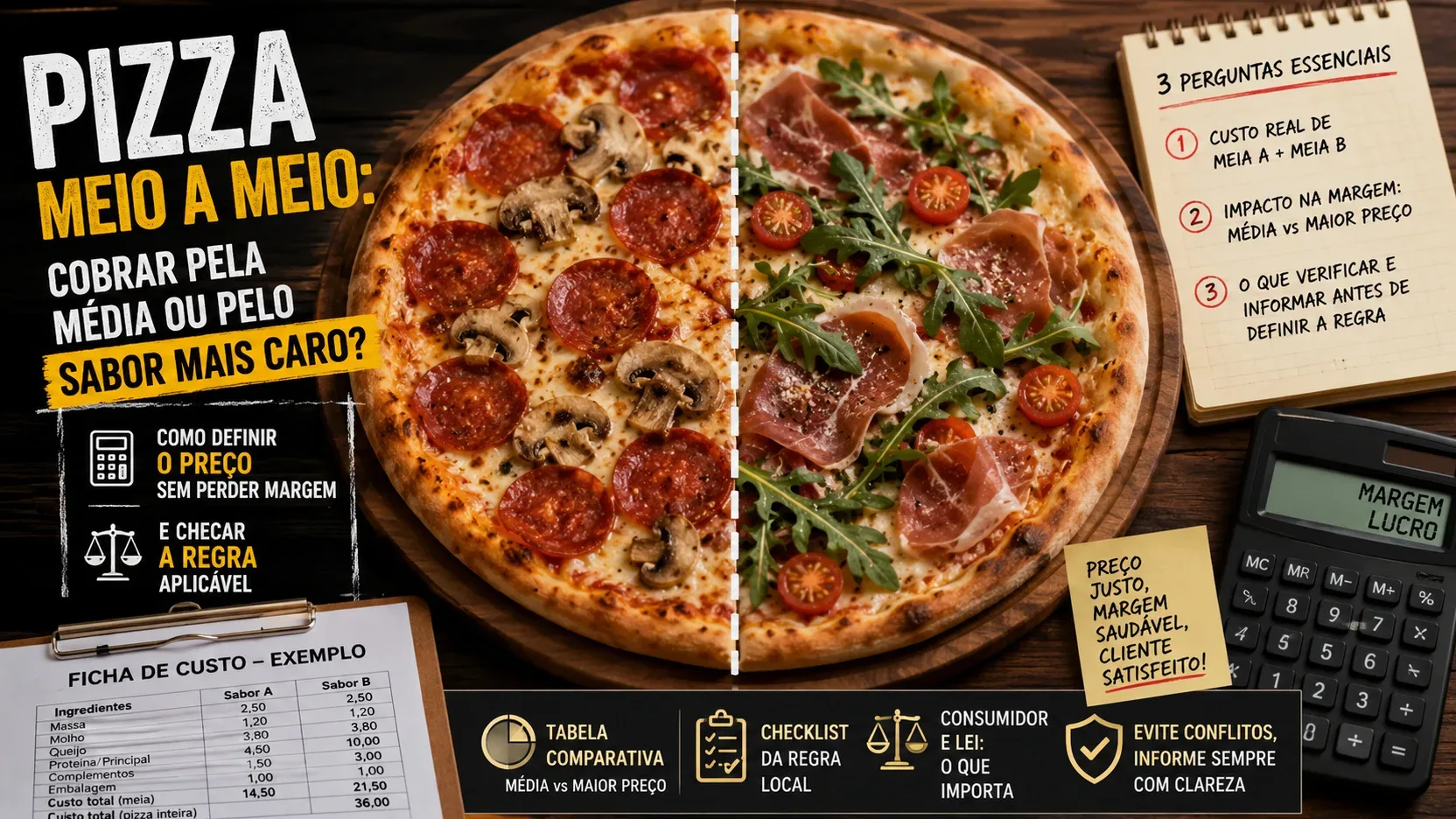
Charging pizza half and half for the most expensive flavor can increase the margin on that sale, but that doesn't mean it's the only financially secure way. If the prices of the flavors were created based on consistent technical sheets, charging based on the average tends to preserve the economic logic of the two flavors. The correct decision starts with the real cost of the combined pizza, goes through the contribution margin and only then becomes a menu rule.
It is also not safe to treat the legal issue as a ready-made sentence. In the general federal consumer legislation consulted, there is no specific formula determining that every pizza with two flavors must be charged for the average or, on the contrary, for the most expensive flavor. What appears clearly is the duty to inform the price and conditions of the offer correctly, precisely and clearly. In addition, local bodies may adopt their own guidelines. Therefore, commercial policy and customer communication need to be decided together.
The calculation starts with the technical data, not with market customs
The first mistake is to start with the question “how much do other pizzerias charge?” before knowing how much your pizza costs. Competition matters, but it does not replace technical data. Sebrae guides food businesses to record ingredients, quantities, costs, yield and sales price, precisely because controlling the cost per preparation is the basis for reducing waste and making pricing decisions.
For a half and half pizza, the form needs to separate what is common to the entire pizza from what varies by flavor. Dough, sauce, part of the cheese, packaging and other common items should not be duplicated just because there are two flavors. The specific ingredients of each topping must be in the proportion actually used.
If production is perfectly proportional, the cost of a half A and half B pizza will be very close to the average between the cost of whole pizza A and the cost of whole pizza B. This approximation stops working when there are minimum portions, ingredients that cannot be divided accurately, additional waste, extra assembly time, dividers, specific edges or another step that actually increases the cost.
A simple formula for the cost of combo pizza
Think of the direct cost of the half-and-half pizza as the sum of the common cost of the whole pizza plus half the specific cost of flavor A and half the specific cost of flavor B.
Half-and-half cost = common cost + 50% of coverage A + 50% of coverage B + combination-specific additional costs.
The last installment should only exist if there is a real and measurable cost. Putting a generic value like “half and half rate” without knowing what it covers can hide a pricing problem rather than solving it.
Complete example: two flavors with different costs and prices
Consider an illustrative example. The pizzeria calculated R$15.50 in common direct cost per pizza, including dough, sauce, base cheese, packaging and other items that remain the same regardless of the flavor. Flavor A topping costs R$6.00 when used on an entire pizza. Flavor B coverage costs R$ 14.00.
In this scenario, the entire pizza A has a direct cost of R$21.50. A whole pizza B has a direct cost of R$29.50. For pizza half A and half B, there is R$ 15.50 for the common cost, R$ 3.00 for half topping A and R$ 7.00 for half topping B. The direct cost of the combination is, therefore, R$25.50.
Now suppose that the menu price of flavor A is R$48.00 and that of flavor B is R$68.00. The average price of the two flavors is R$58.00. The charge for the most expensive flavor would be R$68.00.
The difference between the two methods is not R$20.00, which is the distance between the prices of whole pizzas. As the average is in the middle of the range, the difference in revenue for the combined pizza is R$ 10.00.
What happens to the margin in the average price
To avoid confusing revenue with profit, use contribution margin. It shows how much is left over from the sale after the direct cost and expenses that vary with the sale itself, before paying fixed expenses and forming the final result of the business.
In this example, we will use a didactic hypothesis of 8% of variable expenses on sales. This percentage is not a universal reference for pizzerias; it only serves to show the mechanics and should be replaced by the actual percentages for each channel.
With an average price of R$58.00, variable expenses would be R$4.64. Subtracting the direct cost of R$25.50 leaves a contribution of R$27.86. The contribution margin is approximately 48.0% of the price.
With a charge of R$68.00, variable expenses would be R$5.44. After the same direct cost of R$25.50, the contribution would be R$37.06, equivalent to approximately 54.5% of the price.
Charging the highest price improves the contribution of this sale by R$9.20, not R$10.00, because part of the additional revenue also suffers the variable expense of 8%.
The average can preserve profitability when prices are well set
Note what happens to the whole flavors. Pizza A, sold at R$48.00, generates a contribution of R$22.66 after the direct cost of R$21.50 and 8% of variable expenses. This corresponds to approximately 47.2% of the price.
Pizza B, sold at R$68.00, generates a contribution of R$33.06 after the direct cost of R$29.50 and 8% of variable expenses. The margin is approximately 48.6%.
The combination charged by the average, with a margin of approximately 48.0%, falls between the two results. In this example, therefore, charging the average does not destroy the margin. The reason is simple: the combined cost was also in the middle of the costs of the two flavors.
This is the question that needs to be answered with data. If the margin drops too much when using the average, you need to find out why. There may be an underpriced flavor, an outdated technical sheet, unaccounted for waste or a real extra cost in assembling the combined pizza.
How to transform a margin target into a minimum price
The pizzeria can do the opposite reasoning. Instead of just asking which rule to charge, you can define which contribution margin you need to preserve.
A practical way is to use the relationship between direct cost, percentage of variable expenses and desired contribution margin.
Minimum price = direct cost / (1 - percentage of variable expenses - desired contribution margin).
With a direct cost of R$25.50, variable expenses of 8% and a target contribution margin of 48%, the calculated minimum price is approximately R$57.95. The average price of R$58.00 practically reaches the target.
Now imagine that the operation discovers R$1.20 in real additional cost on each half-and-half pizza, due to loss of yield and assembly. The direct cost would rise to R$26.70. Maintaining the same 8% of variable expenses and the target of 48%, the minimum price would rise to approximately R$60.68.
This second result changes the decision. The simple average of R$58.00 would no longer support the target. Still, this does not prove that charging R$68.00 is the only solution. The company can review flavor prices, correct the technical data sheet, reduce waste or structure another transparent policy, as long as it is financially coherent and legally reviewed.
Average or most expensive flavor: the financial criterion
Charging by the average makes more sense when the cost of the combined pizza approximately follows the average cost of the flavors and when the resulting price preserves the minimum margin defined by the company. It's an intuitive rule for the customer and reduces the distance between what was served and what was charged.
Charging for the most expensive flavor increases the unit contribution whenever the cost of producing the combined pizza remains the same. This gain, however, is a commercial decision, not an automatic cost correction. If the justification is just “that's how the market does it”, the company still doesn't know if its own pricing is healthy.
The best policy is the one that can be explained in one sentence and demonstrated in a cost spreadsheet. If the rule requires several improvised exceptions at the checkout, the problem probably started before service.
What federal legislation requires more clearly
The Consumer Protection Code establishes, in art. 6th, item III, the right to adequate and clear information about products and services, including price. The arts. 30 and 31 reinforce that a sufficiently precise offer binds the supplier and that the presentation of the product or service must provide correct, clear, precise and conspicuous information.
Decree nº 5,903/2006, which regulates price information, details these concepts. He defines clarity as information that can be understood immediately and easily, without requiring
consumer interpretation or calculation. It also determines that the price is reported correctly, clearly, precisely, conspicuously and legibly.
In practice, this recommends an important caution for half-and-half pizza: don't let the customer discover the rule just from the bill. If the pizzeria charges the average, the most expensive flavor or another formula allowed after legal review, the rule must appear before confirming the order. Whenever possible, the system, the digital menu or the attendant should show the final total, avoiding transferring the bill to the consumer.
The freedom of price formation is also not absolute. The art. 39 of the Consumer Protection Code prohibits, among other practices, demanding manifestly excessive advantages and raising the price of products or services without just cause. The application of these devices depends on the specific case, so it is not correct to transform any difference between average and highest price, alone, into an automatic conclusion of legality or illegality.
The example of Procon-Santos and the limit of general rules
An official material from Santos City Hall and Procon-Santos, published in 2016 and updated in 2021, treated charging for the highest value as a permitted price differentiation, as long as the method of charging was clearly and openly informed before the request. At the same time, the municipality created an optional campaign to encourage pizzerias to charge an average price for flavors.
This example is useful precisely because it separates two things. One is the agency's preference for a practice considered more favorable to the consumer. Another is the statement, in that local administrative context, that differentiation could exist as long as it was adequately informed.
Don't turn this Santos case into a national rule. It is a local administrative and historical reference. Before defining your pizzeria's policy, it is necessary to check the applicable legislation in the municipality and state, the current guidance of the Procon responsible for the region and any specific decisions or rules that affect the business.
Legal review is an implementation stage
This section provides a general reading of federal regulations and a local administrative example. It does not replace legal advice or consultation with the competent consumer protection body.
Before publishing a commercial policy, changing menu, team training or sales communication based on this interpretation, the recommendation is to submit the rule to qualified human review. The objective is to confirm whether there is a state or municipal rule, recent administrative guidance or contractual particularity that changes the conclusion to the location of the pizzeria.
How to inform the rule without creating friction in the order
The information must appear where the purchasing decision takes place. On a printed menu, the rule may be next to the pizza section or the option of two flavors. On the website, own app, WhatsApp or marketplace, it must be visible before confirming the order.
Avoid vague phrases such as “consult conditions” when the condition determining the price is already known. An operational wording must say exactly what the logic is: average price of the chosen flavors, price corresponding to the flavor with the highest value or another rule reviewed and adopted by the house.
When the total depends on the combination, show the final value before closing the order. This is better than requiring the customer to calculate the average mentally and also reduces arguments at the register.
The team needs to use the same explanation every shift. If the menu states average, but the server says “the most expensive is always worth it”, there is an offer and operational failure. If the application calculates a value and the store tries to charge another for no previously informed reason, the problem stops being just one of margin and starts involving trust and compliance with the offer.
A decision method for the pizzeria
First, update the flavor specifications and separate common cost, specific coverage, packaging and any actual additional cost of the combination. Don't use sales price as a shortcut to estimate cost.
Then, calculate the cost of the half-and-half pizza with the quantities actually served. Compare this cost to the average cost of whole pizzas. If there is a relevant difference, find out where it comes from.
Then apply the channel's actual variable expenses and calculate the contribution margin on the average price. Do the same for the price of the most expensive flavor. The goal is not to automatically choose the outcome with the highest margin, but to understand how much each policy changes the contribution and whether the simplest option for the client still meets the financial goal.
Finally, do the legal and communication check. The chosen rule must be compatible with the guidance applicable to the location and must reach the consumer before purchase, with an understandable final price.
Final checklist before putting the rule on the menu
Is the technical sheet up to date?
Confirm weights, yield, waste, purchase price of inputs and packaging. A business rule does not correct an outdated record.
Was the cost of the half and half calculated using actual halves?
Check that 50% of each coverage corresponds to what the kitchen actually uses. If there is extra cost, measure it rather than estimating out of habit.
Was the margin calculated as a contribution margin?
Separate direct cost and variable sales expenses. Do not call the remainder from this stage net profit, because fixed expenses still need to be paid.
Does the average price meet the minimum target?
If it meets, the company knows it can adopt the average without sacrificing the defined goal. If it doesn't work, investigate costs and pricing before concluding that the only way out is to charge the most expensive flavor.
Is the rule visible before the request?
The customer must know how the combination will be charged before confirming. The less interpretation and calculation he needs to do, the better.
Does the final total appear in the sales channel?
In digital, the value must be presented before confirmation. In human service, the final price must be able to be informed without improvisation.
Do all channels tell the same story?
Physical menu, counter, telephone, WhatsApp, website and application must reflect the current policy in each context. Differences must be intentional, documented and clearly informed, not the result of old registration.
Has the rule undergone local legal review?
Check the current guidance from the competent Procon and the existence of state or municipal regulations. As the topic involves consumer rights, validate the final draft with a qualified professional before transforming the calculation into commercial policy.
The main point: fair price for the operation needs to be demonstrable
The discussion about half-and-half pizza often starts as if there are only two answers: average or more expensive flavor. For pizzeria management, the safest sequence is another.
First comes the real cost. Then the margin. Next, the business rule. Finally, how to inform and the legal review applicable to the location.
In the example of this article, charging an average of R$58.00 maintained approximately 48% contribution margin because the combined cost was also between the costs of the two flavors. Charging R$68.00 increased the contribution, but this gain came from the price policy, not from the higher cost of the pizza.
When the pizzeria knows this difference, the choice stops being a counter tradition and becomes a management decision. And when the rule is clearly informed before the order is placed, the company reduces the risk of turning a bill worth just a few reais into a conflict with the customer.
Sources for checking before publication
In terms of costs and price formation, Sebrae materials were consulted on technical sheets for food businesses, cost composition and sales price formation for food and beverages.
On the legal side, the Consumer Protection Code, Law No. 8,078/1990, was consulted, especially arts. 6th, 30, 31 and 39; Law No. 10,962/2004, on offering and displaying prices; and Decree No. 5,903/2006, which regulates price information to consumers.
As a local administrative example, official material from Santos City Hall and Procon-Santos was consulted on the Consumer Friendly Pizzaria campaign, published in 2016 and subsequently updated. The campaign voluntarily encouraged the average price and, in the same material, highlighted the need to clearly inform the method of charging.
These sources should be double-checked in the final human review, especially as local administrative guidance and supplementary standards may change.