
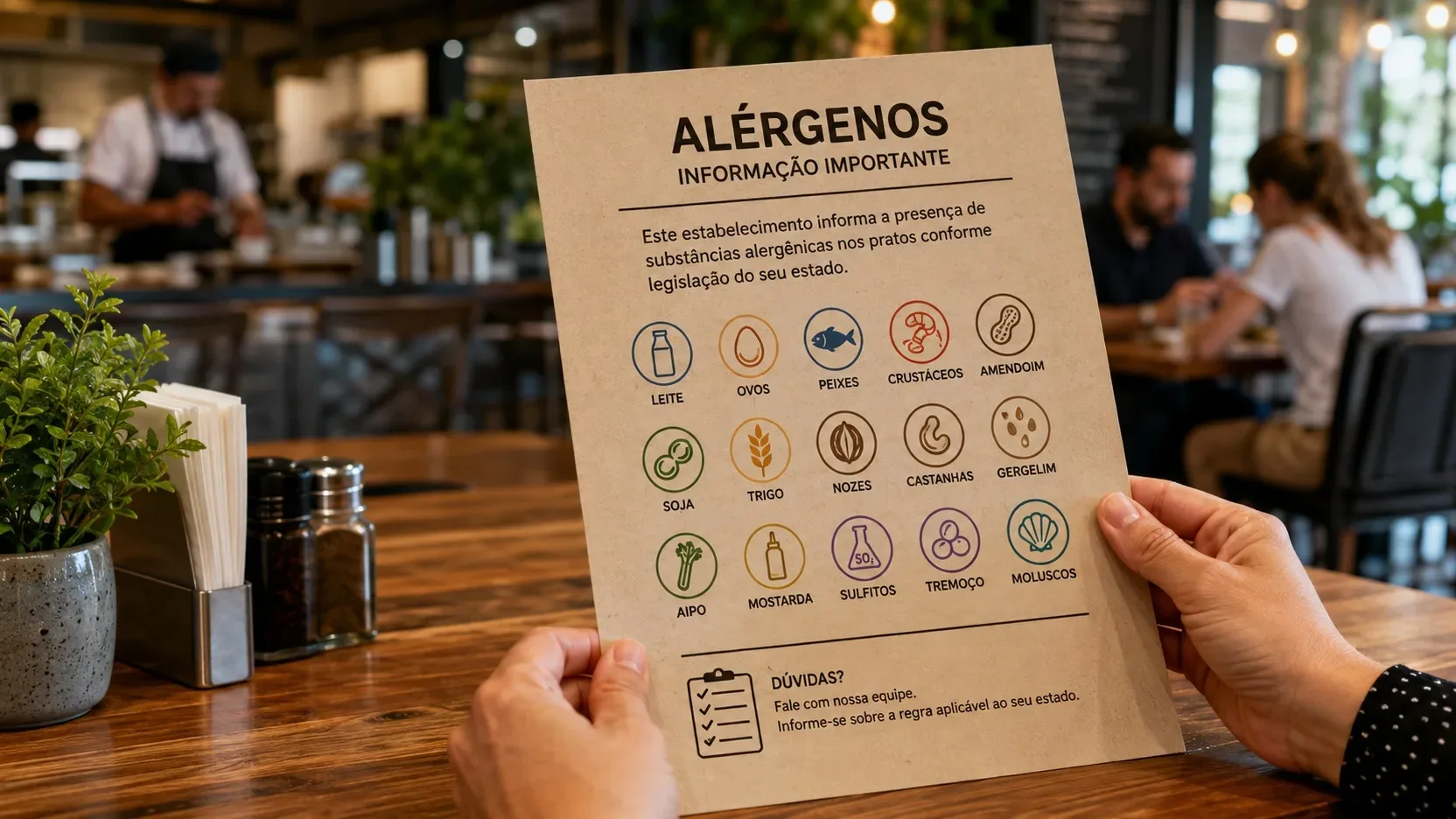
Is my restaurant obliged to indicate allergens on the menu? The answer should not start with a national list of icons. It depends on where the establishment operates, the type of food offered and the standard that effectively achieves that operation. Anvisa's federal rule consulted for this material deals with the labeling of packaged foods; at the same time, states can impose specific duties on menus, as is already the case in Ceará and Bahia.
This changes the correct way to check the obligation. Copying warnings used on industrial products to the menu may be insufficient, excessive or simply incompatible with local law. The cover image of this article itself is illustrative: the icons shown in it should not be treated as a ready-to-use national list. Compliance must come from the current text applicable to the establishment.
Is my restaurant obliged to inform?
The first point is to separate three layers. The first is federal labeling and consumer protection legislation. The second is state and municipal legislation, which can create a specific obligation for restaurants, bars, bakeries, hotels, food trucks, self-services and other food services. The third is the operational reality of the business itself: recipes, ingredients supplied by third parties, formulation changes and cross-contact risk.
The Consumer Protection Code establishes a broad duty to provide information. The art. 31 requires that the offer and presentation of products and services provide correct, clear, precise and conspicuous information, including on composition and risks to health and safety. This duty is relevant to food, but does not replace a local law that details which substances must appear, where the information must be located or what format must be used.
So the practical question is not just "is there a standard on allergens?". It's "which rule applies to my establishment, in this city and in this state, on this date, and what it orders to do
on the menu, at the counter, self-service, delivery or another channel?".
What Anvisa’s federal rule covers
Anvisa's RDC 727/2022 provides for the labeling of packaged foods. It requires, for products within its scope, information such as a list of ingredients, warnings about the main foods that cause food allergies and a warning about lactose. The resolution also establishes declaration formulas for allergens and regulates the warning of the possibility of cross-contamination.
This scope should not automatically be converted into an obligation to place the same warning next to every dish in every restaurant in the country. The DRC itself provides exceptions for packaged foods that are prepared or portioned and sold in the establishment itself, in addition to foods packaged at the point of sale at the consumer's request. For products intended exclusively for food service use, certain information may appear in the documents accompanying the product.
The operational consequence is important: the RDC is an essential source for understanding labeling, suppliers and warning language, but the specific duty to inform on the menu may come from another standard. On August 18, 2026, PL 246/2025, which proposes making the presentation of information about allergens mandatory in food services, was still being processed in the Senate. Project in progress should not be treated as law in force.
Bahia: Law 14,863/2025 and deadline for adaptation
In Bahia, the Legislative Assembly records that Law 14,863/2025 was enacted on February 12, 2025 and published on February 13, 2025. The approved text reaches bars, restaurants, hotels, fast-foods, food-trucks, ice cream shops, sweet shops, delicatessens, bakeries and other establishments that sell products ready for immediate consumption, requiring information on the presence of allergenic foods in menus, menus and the like.
The text also provides that self-service restaurants or establishments with food displays place the information on the food identification label. Non-compliance is treated as a health infraction, without prejudice to other applicable responsibilities. The art. 6th of the approved text granted 12 months, counting from publication, for the necessary adjustments. As the publication took place on February 13, 2025, this adaptation period already took place in February 2026.
There is, however, a legal detail that should not be ignored. The Bahian law expressly refers to Anvisa's RDC 26/2015, including its annex and articles 6 to 8. Anvisa informs today that RDC 26/2015 was revoked and consolidated by RDC 727/2022. This creates a question of interpretation about how to currently apply the remission made by state law. Before publishing a standard of icons or literally reproducing the list of the old resolution, the establishment in Bahia must check the consolidated legal text, inspection guidelines and possible regulations, with legal review.
Ceará: Law 17,899/2022 brings its own list and format
In Ceará, the official base of the Legislative Assembly identifies Law 17,899, of January 11, 2022, republished due to incorrectness in the Official Gazette of February 17, 2022. It covers bars, hotels, restaurants, fast-foods, food-trucks, ice cream shops, sweet shops, delicatessens, bakeries and the like that sell products ready for immediate consumption.
Cearense law is more prescriptive. It requires that the menu inform the presence of gluten, lactose, milk, fish, almonds, dyes, nuts, soy, eggs and crustaceans; determines that the information is next to the name of each product; and provides for the use of constant attachment icons. It also requires a visible indicative table and takes the information to identification labels in self-services or food displays.
Inspection and penalties are, according to the text, the responsibility of consumer protection bodies, and the law provides for a fine in accordance with the Consumer Protection Code. The diploma came into force on the date of publication and granted 180 days for establishments to adapt. This transition deadline has already passed.
The example of Ceará shows why a generic caption does not solve the national problem. The law itself brings together items of different natures, such as gluten, lactose and dyes, as well as foods associated with allergies.. The establishment must comply with the list and format of the standard that reaches it, and not replace this wording with an internally created taxonomy.
Allergy, intolerance and celiac disease are not the same thing
Food allergy involves an immunological response to certain foods or proteins. Lactose intolerance is another condition: it is related to lactose digestion and is not equivalent to allergy to milk proteins. Celiac disease is also not classified by Anvisa as a food allergy; is an autoimmune disease triggered by gluten in susceptible people.
This difference is important on the menu because a single expression such as "allergens" may not cover everything that local legislation requires to be communicated. At the federal level, Law 10,674/2003 requires the expressions "contains Gluten" or "does not contain Gluten" on the labels of processed foods. RDC 727/2022 deals, among other points, with warnings about allergens and lactose in packaged foods. These are regimes that are related, but should not be confused.
It is also risky to transform an operational declaration into an absolute promise of security. Saying "does not contain" or using an absence icon may be interpreted by the consumer as a guarantee. If the kitchen shares equipment, utensils, oil, countertops or storage, the risk of cross-contact needs to be technically analyzed. On federal labeling of packaged foods, the warning about the possibility of cross-contamination is not a guess: the rule links it to an Allergen Control Program.
How to check the applicable rule before publishing the menu
Confirm the establishment's territory
Start with the address of the operation. Search state and local legislation, not just generic search results. The fact that a law exists in Bahia or Ceará does not authorize it to be applied in another state. For chains with units in different locations, the national menu standard must be compared with the requirements of each jurisdiction.
Open the official source and check the status of the standard
Use the official portal of the Legislative Assembly, the state government, the city council or the corresponding official journal. Check the law number, publication date, republications, amendments, revocations, adaptation period and possible regulation. If the text refers to another standard, as occurs in Bahia with the old RDC 26/2015, also check the current status of this reference standard.
Read who and what is within range
Don't stop at the menu. See which establishments the law names and which offer it regulates. Some standards speak of products ready for immediate consumption; others may reach self-service, storefronts, labels, printed menus, digital menus or specific sales channels. The detail changes the implantation procedure.
Exactly map the content and position of information
Identify which substances must be declared, whether the standard requires specific words, icons, legend, highlighting, information next to the name of the dish or identification label. Do not add a list imported from another country or state as if it were a local requirement. If the restaurant wants to provide information beyond the legal minimum, the additional information also needs to be correct and operationally supported.
Connect the menu to technical sheets and suppliers
Consumer information is only reliable if there is an updated internal database. Recipe, brand replacement, ready-made seasoning, sauce, outsourced dessert and change in supplier formulation can change the allergen profile. Labels and documents that accompany ingredients intended for food service need to be included in the technical data sheet update flow.
Treat cross-contact as a process, not a footer
The kitchen must know where the risk may arise and who can change a statement. A generic phrase that "all dishes may contain traces" may seem prudent, but it can deprive the menu of its usefulness and does not necessarily meet the format required by local regulations. The warning must reflect actual control of ingredients, storage, preparation, utensils, equipment and cleaning.
Do legal and nutritional review before publishing
As the topic involves legal obligations and food safety, the final version of the menu must undergo qualified human review. The legal review confirms jurisdiction, validity, sanctions and interpretation of normative references. The nutritional or technical review checks ingredients, terminology, preparation sheets and consistency of statements with the kitchen process.
What not to do when creating icons
Do not use the list of allergens in a ready-made artwork as if it were national legislation. Do not treat lactose as a synonym for milk, nor gluten as a synonym for wheat allergy. Do not copy warnings from an industrial label onto a dish without checking whether the menu standard requires the same language. And don't post a statement of absence that the operation can't sustain.
It is also not worth relying solely on a sector entity page or a search summary when the decision is one of compliance. These sources can help locate the problem, but confirmation must come from the official text and your current situation.
The right question is local, current and operational
For a restaurant, "is it mandatory to report allergens?" there is no single answer based on a percentage, a ready-made table or an isolated federal resolution. The safe path is to identify the jurisdiction, open the current rule, check the required scope and format and only then transform the rule into a menu, labels and internal procedures.
In Bahia, Law 14,863/2025 has already passed the 12-month adaptation period, but its reference to RDC 26/2015, today revoked by RDC 727/2022, deserves careful legal analysis. In Ceará, Law 17,899/2022 provides a list, icons, position of information and rules for self-service. Anywhere, the decision to publish must be supported by ingredient documentation and a process capable of tracking recipe changes and cross-contact.
Before posting the menu, record which standard was checked, on what date, which version of the text was used and who validated the information. This small trail of revision reduces the risk of maintaining an outdated statement when the law, a supplier's formulation, or the kitchen itself changes.