Instagram stopped being a “single link in bio” platform a few years ago. In April 2023, Meta announced the expansion of the profile to up to five links. This changes the decision a lot: for many profiles, the bio itself can take the visitor to the website, WhatsApp, store, channel or other destination without requiring an intermediary page.
But the new limit doesn't make link pages useless. It just eliminates an old automatic justification for using them. Today, the most useful choice is not “Instagram or Linktree”, but rather deciding which structure reduces friction and, at the same time, delivers the control that the profile really needs.
What the five native links really change
When there was only one clickable address on the profile, concentrating several destinations on an external page was almost a necessity for those who had a website, store, portfolio, WhatsApp and other channels. With up to five links, Instagram now directly addresses a large portion of these cases.
This makes old guidelines that still say Instagram only accepts a link incomplete or outdated. The current decision needs to be based on the limit of five and the fact that the links are part of the profile's public information.
In practice, native links have two simple advantages: the visitor finds the destination within their own profile and does not need to open an additional page before reaching what they are looking for. The clearer the main intent of the profile, the more valuable this direct path is.
The right question is: what work does bio need to do?
Counting links is not enough. Two profiles with four destinations may need completely different structures. A professional can use four stable links for months. A brand can change campaigns every week, want to measure each button, present products in
specific order and use the same address on Instagram, TikTok, YouTube, Discord, digital card and email signature.
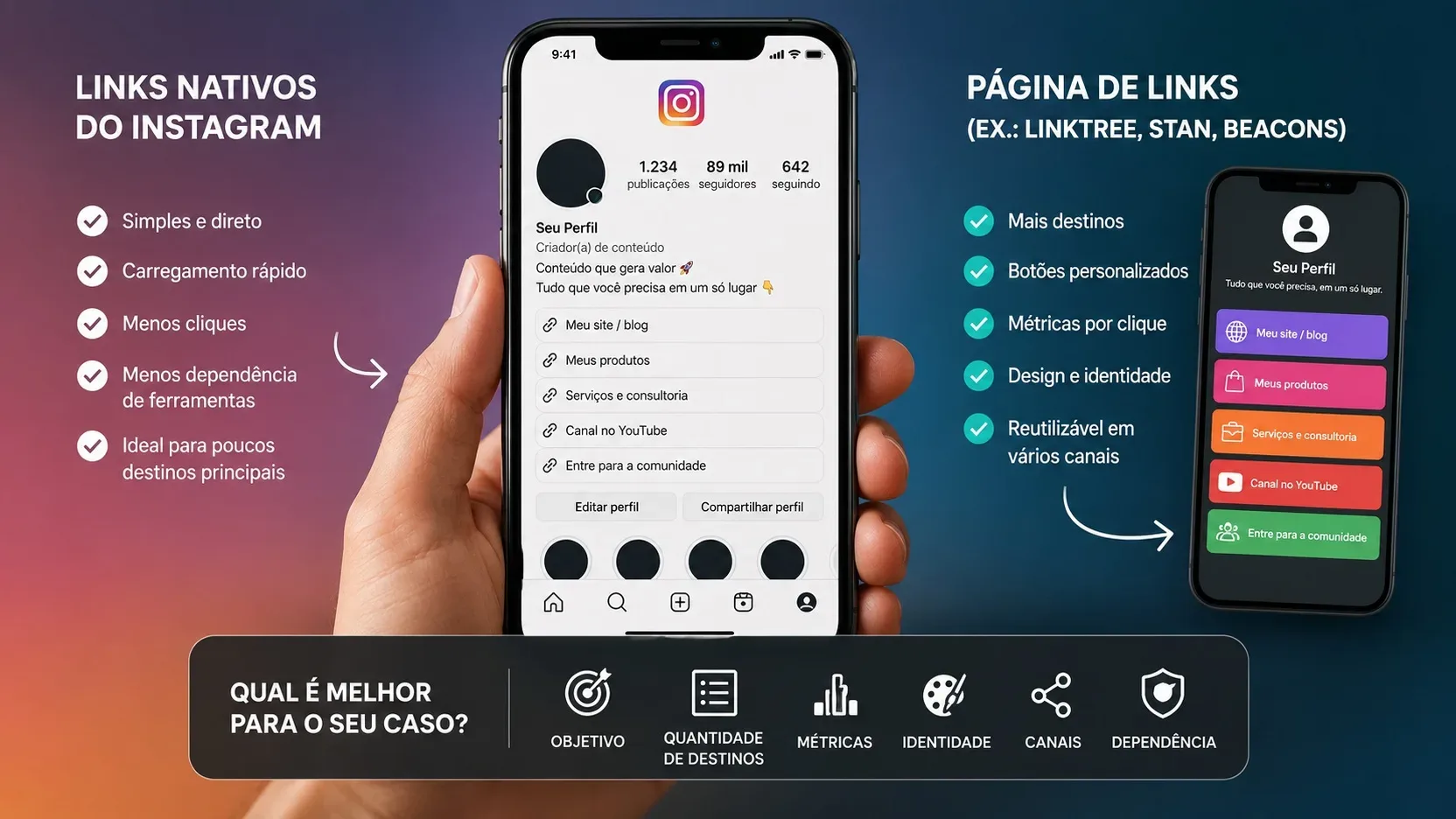
Therefore, the decision must consider number of destinations, stability, need for metrics, visual identity, frequency of campaigns, reuse between channels and dependence on platforms. These criteria form a more useful matrix than choosing a tool out of habit.
Decision matrix: when each option makes the most sense
A dominant destiny
If there is a single main objective, native linking is usually the best choice. This is the case of a campaign that wants to drive all traffic to a sales page, a restaurant that prioritizes the menu, a professional who wants to generate bookings or a creator who is promoting a specific launch.
In this scenario, inserting an intermediate page just to display a button that leads to the final destination creates a step that does not add relevant information. The dedicated page only starts to justify this extra click when it actually organizes choices, presents context or measures something you need.
Two to five stable destinations
Here's the case where native links got more competitive. If the destinations are few, well-known and relatively stable, such as website, store, WhatsApp, portfolio and video channel, Instagram itself may be sufficient.
An external page can still be used, but it is no longer an obligation. If someone doesn't need their own layout, additional content, capture, detailed tracking, or a single URL for multiple channels, keeping destinations directly on their profile reduces complexity and maintenance.
Too many destinations or content that changes frequently
When the number of destinations exceeds what can comfortably fit in the bio, the dedicated page gains strength again. It allows you to organize more options without trying to turn five spaces into an improvised menu.
The advantage grows when links change frequently. Instead of editing multiple profiles and materials for each campaign, you can maintain a central URL and change the page behind it. This is especially useful for creators, portals, catalog businesses, events, recurring releases, and operations that work with different calls throughout the month.
Per-button metrics are part of the decision
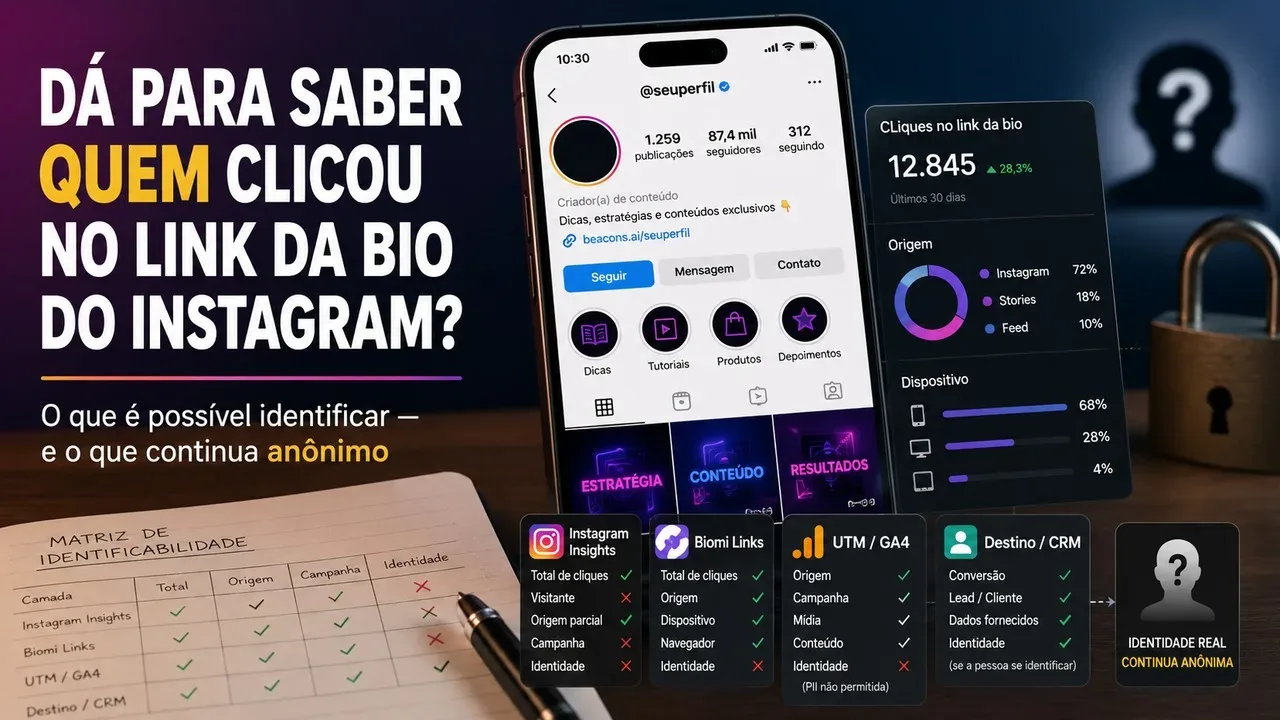
Professional Instagram accounts have access to Instagram Insights, which brings together account and content performance metrics. However, the public documentation consulted by Meta does not provide a detailed report of clicks for each of the links in the bio as a general guarantee. If the strategy depends on knowing exactly which button received the most clicks, where the visitor came from, or which campaign generated the session, it is not wise to assume that native links will deliver this level of attribution.
Link pages may offer this type of analysis, depending on the service and plan. It is also possible to use your own page equipped with analytics tools and campaign parameters. Google Analytics, for example, documents the use of parameters
UTM to identify traffic source, media and campaign.
This doesn't mean that a dedicated page is automatically better. Metrics only have value when someone will actually use the information to decide. For a simple profile, adding a layer of analytics that will never be analyzed can only increase work and dependency.
Visual identity and context before the click
Native links use the presentation defined by Instagram. This is sufficient when the profile only needs to indicate destinations. A dedicated page can act as a small extension of the brand: colors, typography, image, organization, calls, highlights and explanations can prepare the person before the next click.
This space is useful when targets need context. A button called “consulting”, for example, can be accompanied by a short description on its own page, while Instagram tends to favor a more direct list. The intermediate page stops being just an aggregator and starts to function as an orientation stage.
Reuse on Instagram, TikTok, YouTube, Discord and other channels
If the framework will only be used on Instagram, the native feature has a natural advantage. If the same selection of destinations needs to appear on multiple channels, a central URL can greatly simplify the operation.
The person publishes a single address on different profiles and updates destinations in one place. This also reduces the risk of keeping an old link on a forgotten channel. For brands and creators that distribute their presence across multiple platforms, this portability often weighs more than Instagram's limit of five links.
Frequent campaigns
A temporary campaign can be served directly through one of the native links. The problem arises when the campaign changes every week or when different channels need to target different offers.
A dedicated page allows you to preserve a stable address and reorganize the content according to the moment. You can also separate campaigns by source parameters, as long as the measurement configuration is done correctly. For an active operation, the gain is less about “having lots of links” and more about reducing the number of places that need to be updated.
Platform dependency
The word dependence needs to be analyzed carefully. Using only Instagram links reduces reliance on an external link page service, but keeps your entire organization tied to your own profile and Instagram rules.
Using a third-party aggregator creates another dependency: availability, plan limits, resources, and vendor policies. A page hosted on your own domain can offer more portability, because the address belongs to the brand and can continue to be used even if the tool behind it is changed.
Therefore, “link page” is not synonymous with “third-party service”. An owned page and a hosted aggregator are different decisions and should be evaluated separately.
When not using a middle page is the best choice
There are situations in which the most professional solution is precisely not to create a hub. If all profile content leads to a single action, a direct link keeps the message coherent. The same applies when there are few self-explanatory destinations and the user does not need to compare options before choosing.
It also makes sense to avoid the middle page when it doesn't add context, measurement, or organization. A profile with three stable links doesn't need a new tool just because link aggregators have become popular. Architecture should serve purpose, not custom.
When a dedicated page is still clearly useful
The dedicated page wins when the problem stops being simply “where to put my links” and starts involving organization, measurement and management. Lots of destinations, per-button metrics, frequent campaigns, branding, contact capture, cross-channel usage, and need for a permanent URL are strong signs that a central layer might make sense.
Even so, the design must remain simple. A page with dozens of buttons without priority can transfer the bio clutter elsewhere. The real gain comes from hierarchy: highlighting what is most important, removing expired options and organizing destinations according to the audience's intention.
The hybrid solution is often underestimated
The five native links and one dedicated page are not mutually exclusive options. A profile can use one or two direct links for priority actions and maintain, among the others, a link to the central page.
For example, a brand can leave “Buy Now” directly in the bio, include “WhatsApp” as a second destination and use a third link called “All Links” to bring together catalog, networks, support, community and content. This way, those who already know what they want don't face an extra step, while those who need to explore find a complete hub.
This combination also reduces the risk of treating all visitors the same. The person with clear intention is given a short path. The person who wants to know the brand better receives context and alternatives.
How to decide without depending on the name of the tool
If there is a dominant target, prioritize the direct link. If there are two to five stable destinations and you don't need visual tracking or detailed measurement, native links are probably sufficient. If destinations are numerous, change a lot, need to be measured individually or reused across multiple channels, a dedicated page gains value.
If the main concern is independence, differentiate a hosted aggregator from a page on your own domain. And if no option solves everything, use the hybrid model: direct links to priority actions and a hub for the rest.
The limit of five links changed the rule, it did not eliminate the choice
Instagram having up to five links in the bio made the middle page unnecessary for many profiles. This is the main change from the old single-link scenario. However,
link page continues to make sense when it solves a problem that the five spaces don't solve well: scale, metrics, identity, campaigns, portability between channels, or control over the experience.
The best configuration is the one that takes the visitor to the right destination with the least possible friction and keeps the operation simple for those who manage the profile. In some cases, this means using only native links. In others, it means having a central page. And often, it means combining the two.