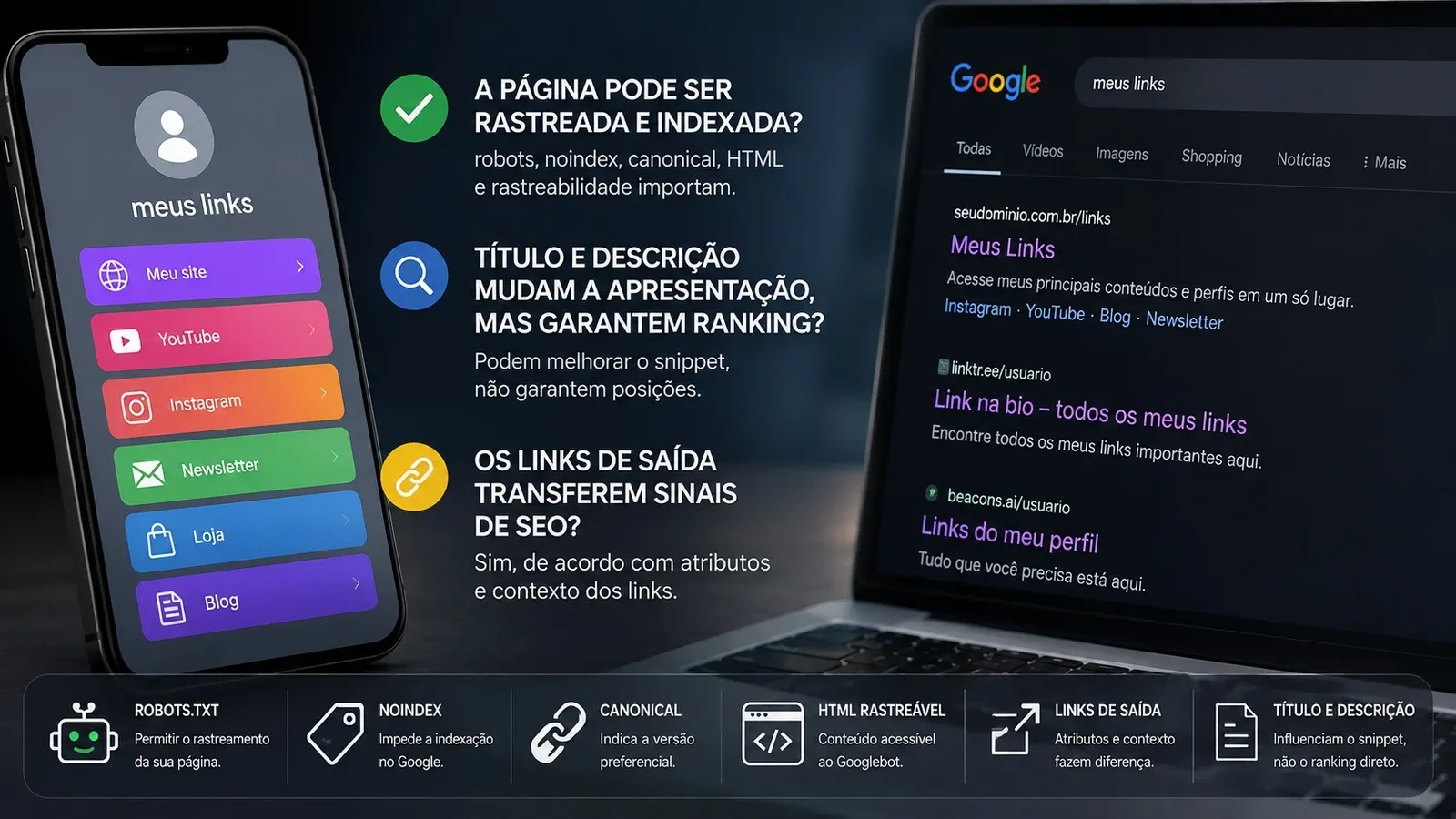
Yes, a link page can appear on Google if it is accessible to Googlebot, responds correctly, and does not have a rule that prevents indexing. This, however, only solves the eligibility stage. Being indexed does not mean occupying a good position, and the presence of several outgoing links does not, in itself, create an SEO bonus for the page or the domain that hosts it.
Confusion often arises because crawling, indexing, presentation in results and ranking are different steps. A configuration can interfere with one of them without producing the effect that many people expect in the others. For a link-in-bio page, the most useful analysis is to separate what allows Google to discover and store the URL, what influences how it appears in search, and what the links actually signal.
First: crawling, indexing and ranking are not the same thing
Google describes the search in stages. First, your systems discover and crawl pages. They then analyze the content and can add it to the index. Only then, when faced with a search, do the systems evaluate which results are relevant to that query. A link page can therefore be crawlable and still not be indexed; it can be indexed and almost never appear; or it may appear for branded searches and not generic terms.
The minimum technical requirements make this difference even clearer. To be eligible for indexing, the page must be accessible to Googlebot, function with a successful HTTP response, and have indexable content. Even when these requirements are met, Google itself points out that indexing is not guaranteed.
Own page or third-party platform: whose URL can rank?
Before discussing tags and attributes, it's worth identifying where the page lives. If the address is something like yourdomain.com/links, the URL belongs to your own website. If the address is in a service
external link in bio, the page that Google crawls and eventually indexes belongs to the domain of that service.
This difference is important because signals associated with a third-party URL do not automatically become signals from your domain. An external page may send traffic to your site and may contain links that Google considers, but the indexed asset remains that external URL. If your goal is to build a page that is part of your own site's architecture, branding, and organic presence, hosting the page on your own domain gives you much greater control over indexing, canonical, content, internal links, and metadata.
This does not necessarily make external services bad. They can be convenient for operation and distribution. The point is not to confuse navigation convenience with ownership of the search asset. For your website's SEO, the first question is always which URL do you control.
The practical matrix: what each setting actually changes
Rather than treating SEO as a single on or off switch, it's safer to check each engine separately. Robots.txt, noindex, canonical, HTML, title, description, and link attributes have distinct functions.
Robots.txt controls tracking, it is not the correct tool to hide a page from search
Robots.txt tells you which URLs certain crawlers can request. Blocking a page there may prevent Googlebot from fetching its content, but it is not a reliable method of ensuring that the URL disappears from results. Google explains that a blocked URL can still be discovered by links from other pages and, in some cases, appear without a normal description.
Therefore, using robots.txt as if it were a deindexation command can produce a contradictory result: the robot does not read the page, but the URL remains known. For a linked page you want indexed, the rule of thumb is not to impede the necessary crawling. For a page you want to keep out of the index, the appropriate mechanism is another.
Noindex is the command that actually asks the page not to enter the index
The noindex rule can be delivered in a meta tag or in an HTTP header. When Googlebot is able to crawl the page and finds this rule, Google says it will remove the page from search results. The important detail is that the robot needs to be able to access the URL to see the noindex.
This is one of the most common errors in diagnostics: blocking the URL in robots.txt and, at the same time, adding noindex. If crawling is prevented, Google may not be able to read the noindex rule. Therefore, if the intention is to exclude the page from the index, it is better to allow robot access and use noindex visibly.
Canonical indicates which version you prefer, but does not act as an absolute order
The canonical rel is mainly used when there are duplicate or very similar pages. It helps indicate which URL should be treated as representative. Google's documentation classifies this indication as a strong signal, but not as an inescapable rule: systems can still choose another canonical if the signals are inconsistent.
On a link page, a canonical pointing to another URL can reduce the chance of that specific page being chosen as the main version for the search. On its own unique page,
the canonical must be consistent with the URL you really want to consolidate. The mistake is to imagine that canonical serves to “give strength” to a page; its central function is to resolve preferences between versions.
Crawlable HTML decides whether links can be reliably discovered
For links, Google's technical guidance is straightforward: the most reliable way is to use an HTML a element with an href attribute. Buttons or elements that look like on-screen links but only rely on script events may not be extracted in the same way.
This matters a lot on bio link pages, because the functional value of the page lies precisely in the destinations it presents. If each visual card is an actual HTML link, Google can more confidently interpret the destination and anchor text. If destinations only appear after an interaction or are assembled in an unconventional way, behavior may become less predictable.
Title and description influence presentation, but do not guarantee position
The title element is an important source for the title displayed in the result, but Google does not promise to reproduce it verbatim. Your systems may also consider the page's visual title, headings, featured text, page content, anchor texts and other references to assemble the title link.
The meta description has a similar function to the descriptive section. Google says that the snippet is created primarily from the content of the page itself and can use the meta description when it best describes that result. Therefore, title and description help to make the presentation clear and coherent, but they are not ranking commands and do not guarantee that the text you define will appear exactly as written.
Rel in links informs the nature of the relationship with the destination
Common links that you expect Google to crawl and interpret don't need a special rel attribute. Sponsored links must be qualified with sponsored, links inserted by users can use ugc and nofollow can be used when you prefer that Google not associate your website with the destination or not follow that link in the normal way.
These attributes are not equivalent to an absolute wall. Google started treating nofollow, sponsored and ugc as signals on how to consider or exclude links in its systems. The practical point is that the attribute can change the treatment of the link, and so it is not correct to assume that all buttons on a bio page transfer the same type of signal.
So outgoing links “pass SEO”?
The short answer is: links are signals to Google, but the expression “pass SEO” oversimplifies what happens. The documentation states that links help discover new pages and are used as a relevancy signal. It also guides you to qualify certain outgoing links according to the relationship between the pages.
A normal, trackable link can be considered by Google's systems. A link qualified with nofollow, sponsored or ugc provides a different indication of how it should be treated. This does not mean that any link from a bio page will produce a ranking boost on the target site, nor that the page sending the link will receive a bonus just for pointing to external sites.
For the site hosting the links page, the clearest SEO gain appears when that page is part of a useful internal architecture: it is crawlable, receives internal links, provides context, and points to relevant pages on the same domain in an understandable way. In this case, internal links help discovery, navigation, and structural understanding. A collection of external links, by itself, is not a documented ranking improvement technique.
Can a links page help the website itself?
It can, but the benefit depends on the role it occupies. On your own domain, a links page can act as a hub for content, products, profiles and other important areas. If there is enough context and clear HTML links, it can help users and search engines find relevant destinations.
What it doesn't do is replace specific pages that respond to specific searches. A bio with six buttons typically has less content and less informational intent than a page dedicated to a product, service, tutorial or category. For brand searches or searches for the name of a person or company, a link page may be a good candidate to appear. For competitive and generic queries, simply centering links does not create enough relevance on its own.
It is also not necessary to turn the page into a long text just to “do SEO”. Ideally, the title, main heading, brief description and link texts clearly explain who the page is about and where each destination leads. Utility for the user remains the most defensible criterion.
How to check a link page without relying on guesswork
On a page you control, the most reliable scanning starts in Search Console. URL inspection shows whether Google can access the page, which version was crawled, and whether there are any indexing issues. The source code and browser tools allow you to check the title, meta description, robots meta, canonical and rel attributes of each link.
It is also worth observing whether the URL responds successfully, whether the main content is present without requiring login and whether the links actually use href. When the page is on a third-party service, you can inspect the public HTML, but you won't have the same level of control or necessarily access to the Search Console for that property. In this scenario, don't assume that the platform uses nofollow, canonical, or noindex in a certain way: check the current implementation.
This check is especially important because platforms can change markup, policies, and rendering. The correct answer to “does this tool pass signals?” it shouldn't come from an ancient myth or a screenshot; it must come from the HTML and rules that are being delivered today.
What to prioritize if you want the page to be found
If the goal is for the page to appear on Google, the first requirement is not to unduly block Googlebot and not to use noindex. The page must respond normally, have indexable content and present a coherent canonical. Next, the title, heading and description must specifically explain who the page is and what the user will find on it.
After that, links need to be crawlable HTML, with clear text rather than generic anchors. If there are paid links, user-generated content, or destinations that you don't want to endorse, the appropriate rel attributes come in as part of the implementation. None of this, in isolation, guarantees position. These are conditions and signs that make the page technically understandable; ranking depends
relevance to the query and the set of signals that search systems evaluate.
The summary that avoids most mistakes
A link page can be found on Google, even when it is on a link in bio service, as long as that URL is public and eligible for indexing. Robots.txt primarily controls crawler access and should not be used as a replacement for noindex. Noindex is the appropriate mechanism for requesting that a page not appear in the index. Canonical guides the choice between similar URLs, without acting as an absolute guarantee. Title and description help influence the presentation of the result, but do not guarantee ranking.
Outgoing links, in turn, can be used by Google for discovery and relevance, and their treatment changes depending on the markup and context. The mistake is to turn this into a formula like “having a bio page improves SEO” or “using Linktree hurts SEO”. The more useful question is another: what URL do you want to strengthen, who controls that URL, and what technical signals is it actually delivering?