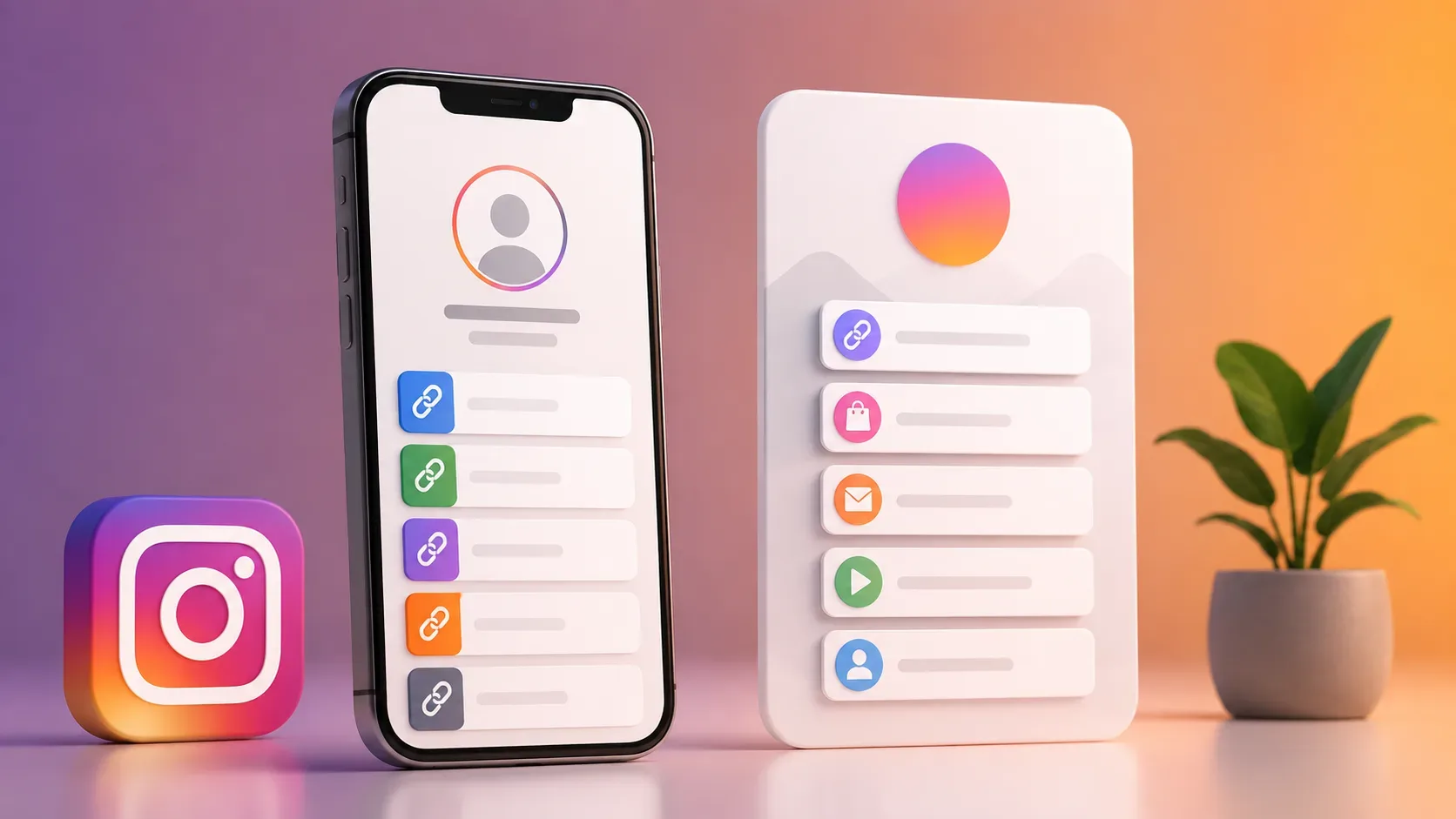
Instagram now allows you to add up to five websites to your profile, and these links can be reordered. In 2026, therefore, using a link page is no longer a necessity for anyone who simply wants to overcome the old limitation of a single address.
This did not make the link pages useless. It just changed the reason for using them.
Whether you have two, three, or five clear, independent destinations, Instagram native links can solve it all with fewer steps. If you need to present services, campaigns, products, content and contacts with their own hierarchy, maintain the same address on different channels or better understand what happens after the visit, a centralized page still makes sense.
The choice, therefore, should not start with “how many links do I have?”, but with a more useful question: does the visitor just need to open a destination or do they need to choose the next step?
Five links solve the limit, not the organization
Instagram's change eliminates an objective problem. According to the platform's own Help Center, it is possible to add up to five websites to the profile and change the order in which they appear.
For many profiles, this is sufficient.
Imagine a professional who only needs to promote their website, WhatsApp and portfolio. There is no automatic reason to insert another page between Instagram and these destinations. A direct link to each place reduces one step along the way: the person taps the profile and goes where they want.
The same reasoning applies to a very specific campaign. If a Reel is taking people to a sign-up that ends this week, sending the visitor directly to the sign-up page tends to be a simpler architecture than sending them to a link center first and forcing them to search again for the aforementioned offer.
Number five, however, does not answer other questions. It does not explain which service should appear first, it does not present a product with image and context, it does not create a portfolio section, it does not separate content from commercial contact and it does not transform several destinations into a coherent presentation.
This is where there is no longer just a problem of quantity and a problem of digital presence architecture appears.
When native Instagram links are enough
Sticking to just the links offered by Instagram is a very reasonable choice when the destinations are few, permanent and easy to understand.
This usually works well when:
- each link has an obvious function;
- there are at most a few really important destinations;
- a campaign needs the most direct path possible;
- no need to display products, galleries or content before clicking;
- Instagram is the main entry point and you don't need to replicate the same structure across multiple channels.
In this scenario, adding an intermediary page just because “everyone uses a link in their bio” can create complexity without delivering proportional benefit.
There is still an important point about metrics. Professional Instagram accounts have access to Insights to track account and content performance. This does not mean that it is necessary to hire or adopt another tool just to have basic data about your performance on Instagram.
A centralizing page adds value when you also want to observe the behavior within that distribution point: which destinations received the most clicks, where the visits came from, which devices were used and how different calls behaved, for example.
When a link page still makes a difference
A links page gains function when it stops being a list of URLs and starts acting as a small presentation layer.
Think of a creator who posts videos, maintains a newsletter, sells a product, receives commercial proposals and participates in a community. Five links can contain five addresses, but do not necessarily explain the relationship between them.
On a centralized page, the creator can prioritize the content mentioned that week, keep commercial contact accessible, place products in their own section and leave secondary networks below. The address remains the same while the internal organization changes depending on the moment.
For a local business, the logic may also be different. Instead of five destinations with the same weight, the page can highlight “Schedule service” or “Request a quote”, while the address, catalogue, social networks and other information remain available as support.
The difference is less in the volume of links and more in the possibility of building a hierarchy.
| Criteria | Native Instagram Links | Centered page |
|---|---|---|
| Path to a specific destination | More direct | Adds a step |
| Number of destinations | Up to five websites in the profile | Depends on the tool used |
| Visual organization | Controlled by the Instagram interface | Can offer its own identity and hierarchy |
| Content beyond links | Limited to what the profile offers | Can include different formats, depending on the platform |
| Campaign update | Requires changing or reordering profile links | The same address can point to an updated internal structure |
| Destination center analysis | Depends on Instagram features and end sites | You can add metrics for the page itself and links |
The table does not produce a universal winner. It shows why the two solutions meet different needs.
In 2026, the hybrid model may be more useful
Using a link page does not force you to abandon the other spaces available on Instagram.
As the profile accepts up to five websites and allows you to reorder them, a possible strategy is to keep a direct destination for the current priority and use another space for a central page with permanent paths.
A release can take first place while it is active. Just below, the central page continues to bring together portfolio, contacts, content, products and other channels.
This model resolves a common tension. Campaigns gain a short path, while the institutional presence does not need to be rebuilt every time a new action appears.
It also avoids turning the links page into a warehouse where everything receives the same prominence. If there are fifteen buttons and none of them tell you what to do first, the problem isn't a lack of space: it's a lack of priority.
The exchange should help someone decide, not just store addresses.
A page can also work outside of Instagram
There's another difference that the five-link limit doesn't resolve: native links belong to the Instagram profile. An external page can also be shared on WhatsApp, TikTok, YouTube, digital card, email signature or any other point where an address is useful.
This allows you to maintain an organized core without rebuilding the same selection on each platform.
This benefit, however, should not be confused with total independence. If the page is hosted on a third-party tool, you continue to depend on the conditions and resources of that service. For those who require their own domain, controlled infrastructure or very specific integrations, their own website may be a more suitable solution.
The choice between native links, links page and full site is a matter of necessity, not maturity. A small profile may need a sophisticated structure; A large company might have a single campaign where the best link is simply the direct address.
Where does Biomi Links come into this decision
Within the Biomi ecosystem, Biomi Links occupies precisely this layer of digital presence. The official product page features resources to bring together links, social networks, contacts, products, services and content in a single address, as well as visual customization, SEO configuration and performance metrics.
The product also supports elements such as WhatsApp, videos, music, galleries, location and offers. In the analytical panel, the public documentation presents tracking of views, visitors, clicks, devices, sources and most accessed links, with queries in periods such as 7, 30 and 90 days.
This puts the tool in a different category than the simple need to “fit more links”. The proposal is to create a page where the visitor understands who is behind the profile, finds organized paths and can be directed according to the priority at that moment.
The Biomi ecosystem itself presents Links as a Digital Presence tool, alongside other independent products connected by the same proposal to simplify digital tasks.
To learn about the ecosystem, visit Biomi. For those who have already identified the need for a destination center, Biomi Links is the tool dedicated to this function.
The most useful decision is to look at the journey
In 2026, it makes no sense to argue that every profile needs a links page. Instagram already offers up to five websites, and this feature can very well solve simple profiles or campaigns that require a direct path.
It would also be hasty to conclude that five links made hub pages obsolete.
A page remains useful when there is something to organize: different audiences, offers, content, services, contacts, campaigns and objectives. Visual identity and metrics can strengthen this decision, but they must serve a clear journey.
If the person already knows exactly where to go, give them the shortest route.
If she needs to understand her options before choosing, organize those options.
And when the two situations coexist, there is no obligation to choose a single format: native links and a central page can work together.