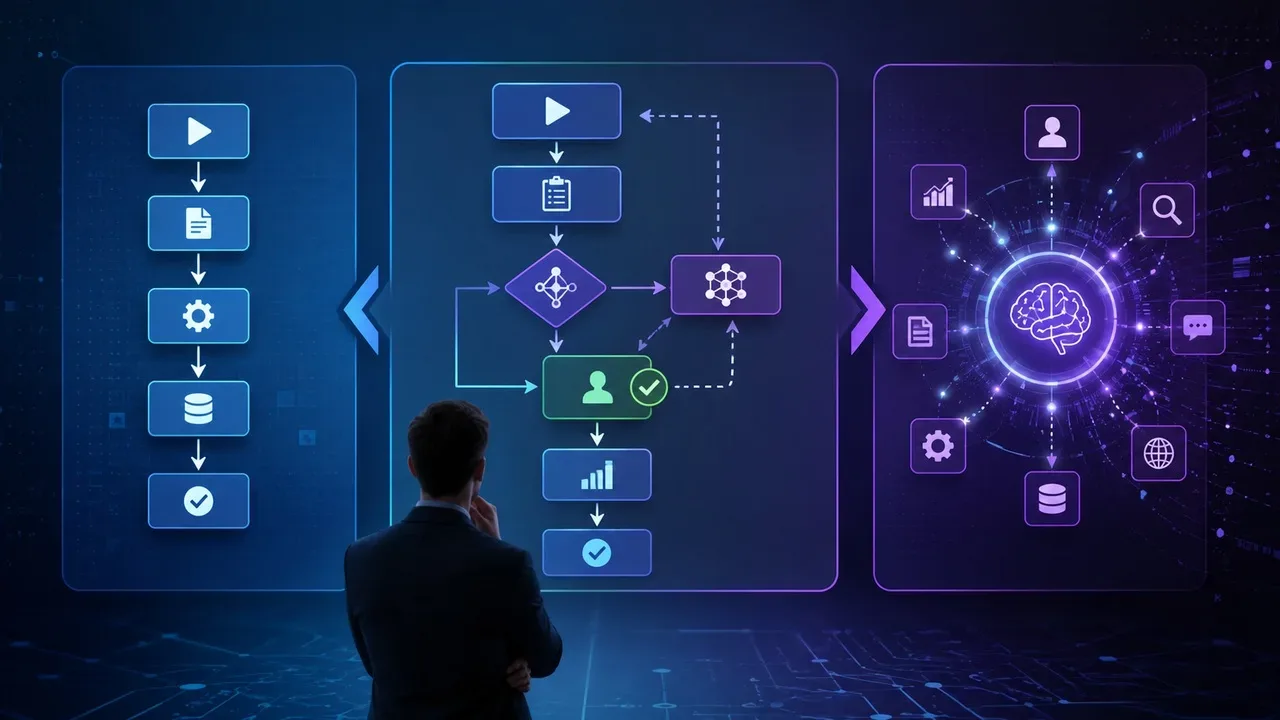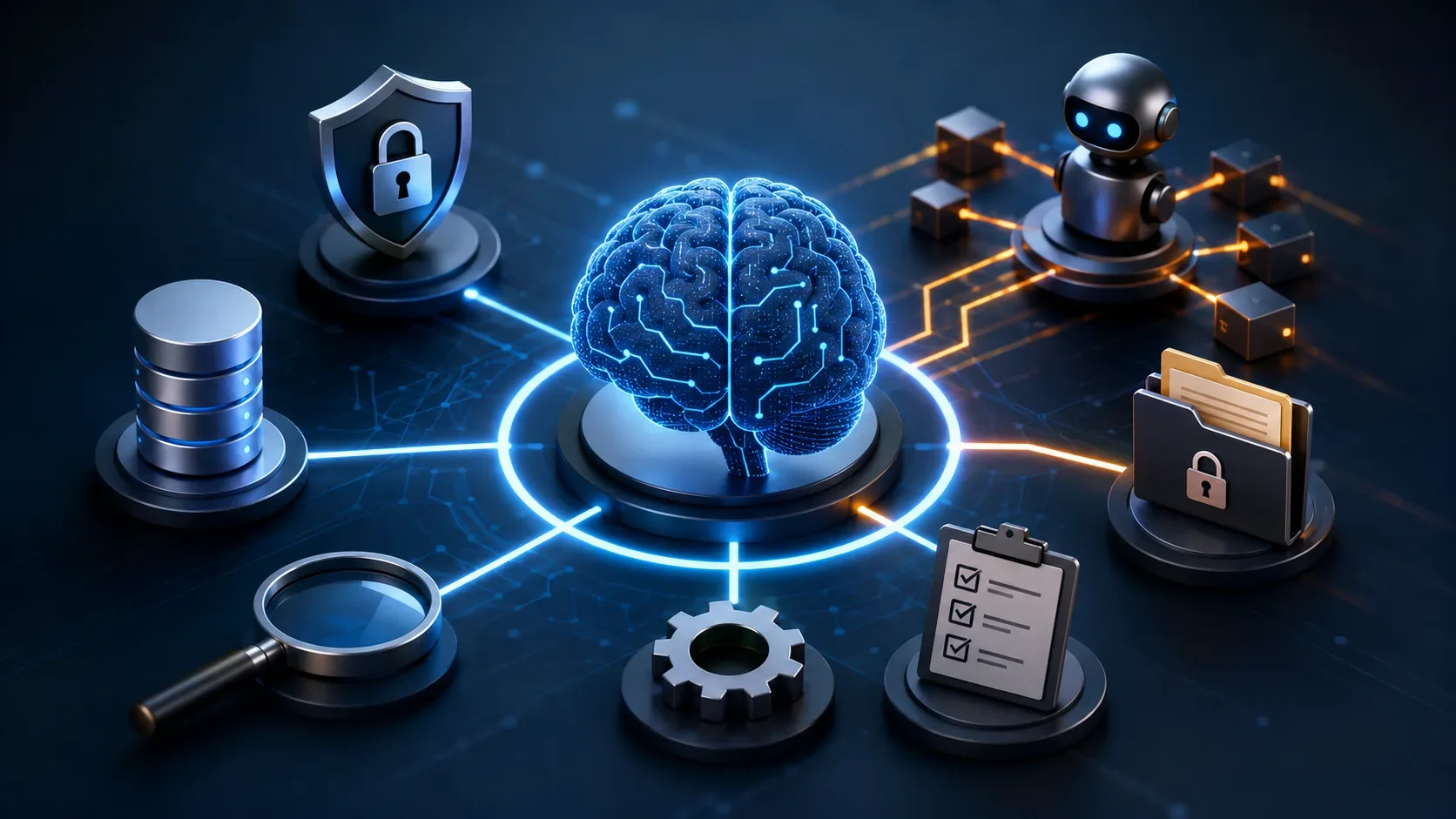
When an AI needs to consult a calendar, search for data in a database, open a ticket or perform an action in another system, someone needs to build the bridge between the model and that system. This bridge can use an API directly. It could be a custom-developed integration. And, in certain cases, you can gain an MCP layer.
The point that often generates confusion is treating these options as substitutes. MCP does not replace the external service API. It standardizes a different part of the architecture: communication between an AI application and servers that provide tools, resources and other contexts.The specification itself provides that an MCP tool can query databases, call APIs or execute other logic.
This distinction becomes clearer when we follow a user task from beginning to end.
API, conventional integration and MCP operate at different layers
An API typically defines how software can request operations or data from another service. In HTTP APIs, standards like OpenAPI allow you to describe operations, parameters, and responses in a machine-readable format.
Conventional integration is the code that connects these points. The developer knows the service contract, implements authentication, assembles requests, processes responses and transforms data into the format required by the application.
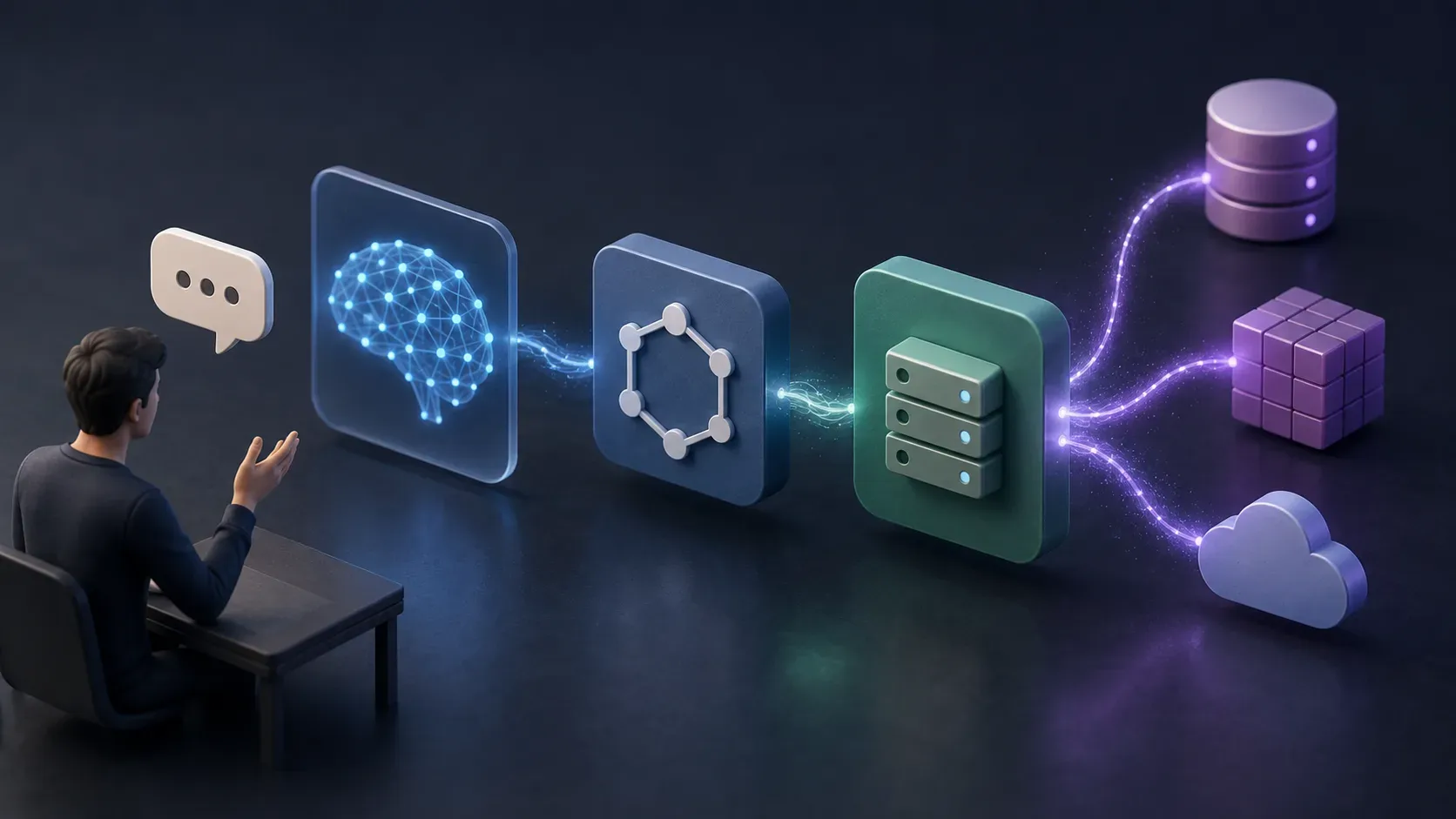
MCP comes in elsewhere: it offers a common protocol for AI applications to discover capabilities offered by servers and interact with them. The official architecture distinguishes the MCP host, which is the AI application; the MCP client, a component used by the host to talk to a server; and the MCP server, which exposes capabilities to these clients.
| Element | What solves | Relationship with the external system |
|---|---|---|
| API | Exposes operations and data of a service | It is an interface of the service itself |
| Conventional integration | Connects an application to a specific API or system | Implements the necessary adaptation code |
| MCP | Standardizes the interface between AI applications and capability servers | The MCP server can, behind the scenes, call APIs, banks, files or other logic |
So the most useful comparison is not “API or MCP?”. The correct question is: does the application just need to access a known service or does it need a standardized layer to present capabilities to AI applications?
The path from an order to the tool
Consider a person asking an assistant: “See my appointments for tomorrow and find free time in the afternoon.”
In an MCP-based architecture, the conceptual flow can be represented like this:
user request → model → application/host → MCP client → MCP server → API or system → result → application/model → user
The path has some important steps:
- The user makes the request in natural language. The application sends the model the necessary context and the tools it can use.
- The model identifies that it needs an external capability. MCP Tools are designed to be discoverable and actionable based on the context of the request, although each application can define its own interface and approval policy.
- The MCP client sends the call to the MCP server. The protocol defines operations such as tools/list, to discover available tools, and tools/call, to request the execution of one of them.
- The MCP server executes the necessary logic. At this point, it can directly query a database, work with files, perform a calculation or call another service's API.
- The result goes back to the AI application. The host decides how to use that response in context and the model can then output the response to the user or continue the task.
This sequence also shows an important nuance: it is not necessarily the model that “speaks MCP” directly. The MCP is part of the application infrastructure that hosts the model.
Tools, resources and prompts are not just different names for endpoints
MCP defines three core primitives that servers can offer: tools, resources and prompts. They exist because an AI application needs to deal not just with actions, but also with contextual data and reusable ways to guide an interaction.
Tools represent executable functions. A server could, for example, offer a tool to create an event, check stock or open a ticket. Each tool has a name and an input scheme that allows the client to understand the expected arguments.
Resources expose information that can serve as context, such as the contents of files, records, schemas or responses from other systems.
Prompts are reusable interaction models that help structure certain flows.
An API can continue to exist underneath all of this. The MCP server often functions as the layer that translates the capabilities of that system into a contract that MCP-compatible applications can discover and use.
An AI can use APIs without MCP
Nothing requires an application with LLM to adopt MCP to access external systems.
It is perfectly possible for the developer to program a consult_orders function, describe it to the model and, when it is activated, make a direct call to the ERP API. Another function can access the CRM; a third, the calendar.
In this case, there is use of tools by an AI, but there is not necessarily MCP. The catalog of functions, the way to present them to the model, communication with each service and adapters can all be specific to that application.
MCP adds value when this specific layer starts to repeat itself: different AI applications need to discover and call external capabilities, each requiring their own integrations for similar services.
When a direct API is still enough
There are at least three situations where adding MCP can create more architecture without solving a real problem.
- An application controls a few stable services. If there is a single product, half a dozen well-defined operations and an integration that will only be used by it, direct calls to APIs may be simpler to maintain.
- The flow is deterministic and does not depend on the discovery of tools by AI. A backend that always receives a payment and immediately consults an anti-fraud API, for example, already knows each step in advance. MCP is not a requirement for this type of conventional integration.
- You control both sides and do not intend to reuse the integration on other AI hosts. If the internal code already adequately encapsulates authentication, errors and data transformation, creating an MCP server may not provide enough benefit.
In other words: having an LLM in the application does not make MCP an automatic requirement.
When MCP standardization starts to make a difference
The gain appears more clearly when the problem stops being just “what do I call this API?” and becomes “how do various AI applications find and use these capabilities?”.
- The same capacity needs to serve different AI applications. An MCP server can expose a standardized interface to compatible clients, reducing the need to create a different adapter for each host. The official documentation precisely presents interoperability between applications and servers as one of the purposes of the protocol.
- Capabilities need to be discovered dynamically. Customers can consult lists of tools, resources and prompts rather than relying solely on statically coded functions within each application. The lists can even change, and the protocol provides mechanisms to inform customers about changes.
- An AI application needs to bring together multiple systems under a coherent interface. The host can connect different MCP servers and combine the discovered capabilities into a catalog used by the application. This is different from forcing the model or each integration to directly know the private contract of all systems involved.
This is the part of the “USB-C” analogy that is usually hidden: the benefit is not in making the connected device disappear, but in reducing the number of different interfaces that the consumer layer needs to know.
MCP also does not eliminate authentication and permissions
Another dangerous simplification would be to imagine that placing MCP in front of a service automatically resolves authorization, credentials and access control.
The current specification has an authorization model for secured MCP servers, based on OAuth, but this addresses the relationship between the MCP client and the MCP server. When that server needs to access a protected API upstream, the boundary still exists.
The protocol's own security considerations make this separation explicit: when an MCP server calls external APIs, it may need to act as an OAuth client for those services, using credentials appropriate to them. The token received by the MCP server should not simply be passed to the external API.
In practice, therefore, an architecture can simultaneously have:
user → AI application → MCP authorization → MCP server → external service authorization → API
This reinforces the idea of layers. MCP standardizes some of the connection and capability discovery; does not erase the security controls or contract of the system behind the server.
The specification also recommends clear controls over the execution of tools and user participation in sensitive actions. The protocol, however, cannot alone enforce all of an application's security policies.
What changed in the July 28, 2026 specification
The comparison became especially relevant after the stable revision 2026-07-28, published on July 28, 2026. As of the consultation on August 14, 2026, it appears in the official documentation as the most recent version of the specification.
One of the main changes was to make the MCP core stateless. The release eliminated protocol-level sessions and the old initialization process; Each request now carries information such as protocol version and capabilities necessary for its processing.
Server/discover was also introduced, which allows you to query versions, identity and capabilities supported by the server. The server must implement this operation, although the client does not necessarily need to perform it before every call.
The change makes it easier to operate MCP servers over more conventional and scalable HTTP infrastructure, but does not change the fundamental relationship discussed here: the protocol remains an interoperability layer for AI applications, and the underlying systems can continue to expose their own APIs, databases, files, or other mechanisms.
Practical decisions begin with the problem, not with the protocol
If an application needs to query a known API, with few stable operations and no prospect of reusing this integration in other AI environments, starting directly with the API remains a coherent choice.
If the challenge is to allow different applications or agents to discover external tools, resources and flows through a common interface, MCP begins to solve a problem that an isolated API was not created to solve.
And the two things can coexist. Perhaps this is the most important architecture to understand:
the API continues to be the system port; the MCP server can be the adapter that presents this system in a standardized way for AI applications.
Before creating an MCP server, therefore, it is worth mapping the existing integrations and asking where the real cost is. If the problem is accessing a service, you probably need the API or other mechanism for that service first. If the problem is to repeat the same adaptation for several AI clients, dynamically discover capabilities or offer a reusable interface for agents, then MCP has its own role.