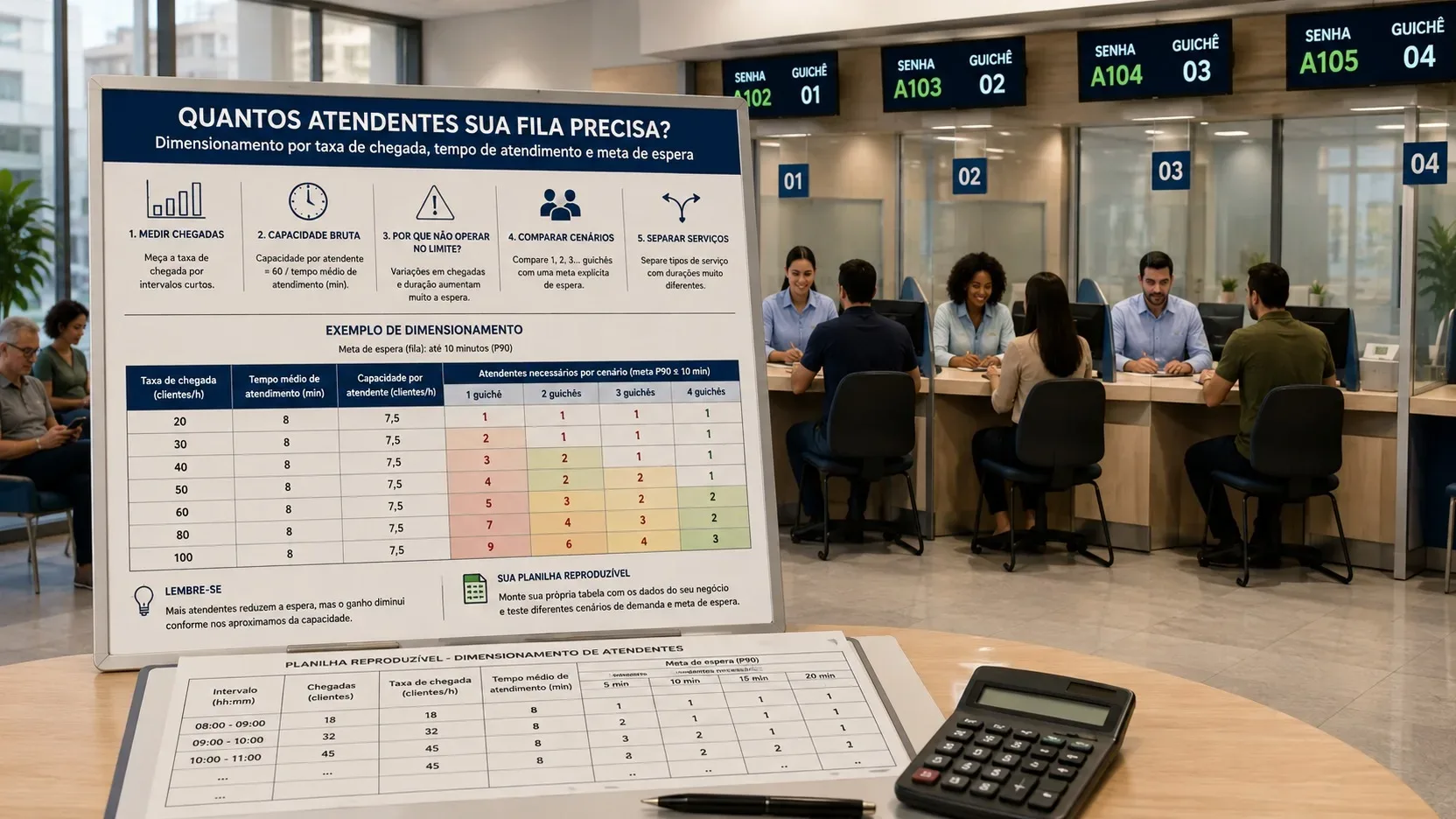
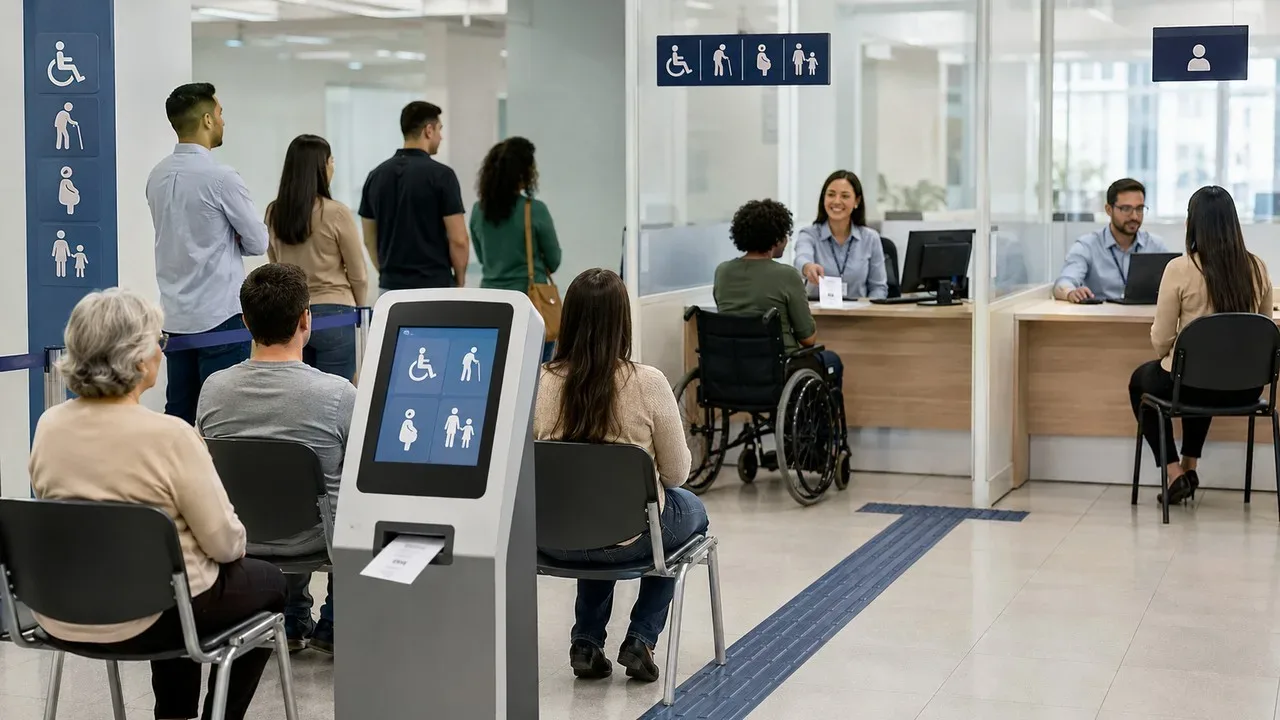
Priority service is not just putting a “preferred” sign next to a cashier. For those who operate a queue, the practical issue is different: identifying who has the right, preserving the order that the rules require and choosing a design of tickets and counters that truly delivers priority. The queue can be physical, virtual or organized by tickets; the right does not disappear because the establishment uses an electronic system.
The best-known federal rule is in Law No. 10,048/2000, today with wording that includes people with disabilities, people with autism spectrum disorder, elderly people aged 60 or over, pregnant women, breastfeeding women, people with infants, obese people, people with reduced mobility and blood donors. But the concrete scope also depends on the type of establishment, other federal laws and state, municipal or sectoral standards. Therefore, the operational configuration must start with the rule applicable to the service, and not with a proportion of calls chosen for convenience.
Priority is a service order right, not the name of a queue
In practice, “preferential queue”, “priority queue” and “preferential counter” are often used as signaling labels. The relevant legal point, however, is the treatment that the person receives. Law No. 10,048 provides for priority service and allows it to be carried out by specific stations, cashiers, counters, lines or attendants. The same law also says what happens when there is no exclusive structure: once the service that is already in progress has been completed, the person with priority must be served before the others.
This distinction resolves a common confusion. Having a separate queue is a possible way to organize the flow. Having an exclusive counter is also important. None of these structures, by themselves, guarantee that priority is working. If the “preferred” queue takes longer than the usual one because it has little capacity, or if the priority ticket window is closed while there are eligible people waiting, the operation can frustrate precisely the effect that the rule intends to produce.
Decree No. 5,296/2004, which regulates priority in public bodies, public service providers and financial institutions, treats priority service as a combination of differentiated treatment and immediate service. Differentiated treatment measures include signage, accessibility, trained staff and a specific service location. At the same time, the current wording of Law No. 10,048 makes clear the contingency mechanism when there is no specific post: priority migrates to the next available service.
Who is entitled under the federal rule
According to the current wording of Law No. 10,048, people with disabilities, people with autism spectrum disorder, elderly people aged 60 or over, pregnant women, breastfeeding women, people with infants, obese people, people with reduced mobility and blood donors are part of the priority care group.
There are two important nuances for internal order. The first is that blood donors enter after all other beneficiaries provided for in the law itself and must present proof of donation valid for 120 days.. The second is that the Elderly Persons Statute guarantees special priority to people over 80 years of age in relation to other elderly people. These specific rules do not authorize inventing a complete hierarchy among all categories when the law has not established one.
Companies or personal attendants of priority holders are served jointly and additionally with the beneficiary. This is different from transforming the companion, per se, into a new priority holder for independent care that has no relation to the person being accompanied.
It's also important not to rely solely on appearance. Deficiencies may not be apparent. Law No. 14,624/2023 made the sunflower string a national symbol for identifying hidden disabilities, but its use is optional and its absence cannot take away rights. The law allows that supporting documents be requested when applicable. A service flow must, therefore, allow the person to inform their condition without forcing them to “seem a priority” to the attendant.
Before configuring the queue, confirm where the rule applies
Law No. 10,048 expressly obligates public offices and public service concession companies and ensures priority in financial institutions. For people with disabilities, the Brazilian Inclusion Law guarantees priority assistance in institutions and public services. For elderly people, the Elderly Persons Statute provides for immediate and individualized preferential care in public and private bodies providing services to the population.
In addition to these federal bases, states, municipalities and specific sectors can establish additional groups, forms of identification, signage, times, queues or their own procedures. Decree No. 5,296 itself attributes to states, municipalities and the Federal District the creation of implementation and control instruments within their competences. In other words: copying the configuration of a bank to a hospital, a city hall, a clinic or a business can produce an error, even when everyone uses a similar password totem.
For a private operation, the initial question should not just be “who appears in Law No. 10,048?”. It is also necessary to check the state and municipal legislation, the nature of the service and specific sector standards. The queuing system executes the rule; it does not replace this check.
Operational matrix: three designs that can work in different ways
Exclusive ticket window for priority
In this design, part of the capacity is allocated to the priority public. The advantage is clarity: the person quickly identifies where they will be served, and the team can follow the queue separately. It is an especially useful solution when the volume of priority services is sufficient to keep the post active or when the applicable standard requires a specific structure.
The risk appears when “exclusive” becomes synonymous with “less capacity”. If there is a single priority position with a growing queue while multiple common windows advance quickly, the formal organization exists, but the effect of priority may be lost.. It is also not safe to assume that a ticket window identified as priority can always serve the general public when it is empty; This possibility depends on the applicable rule and the way the service was structured and signaled.
Password or priority queue with shared attendants
Here, all attendants can receive people from more than one password class. The system separates priority in the call logic, not necessarily at a physical counter. It is a flexible model, but the ordering rule needs to be explicit.
When there is no specific attendant, Law No. 10,048 establishes that the priority person is served immediately after completion of the ongoing service, before other people. In practice, this means that a priority password that goes on hold should not be trapped behind a sequence of common passwords just because the algorithm was configured to alternate calls.
This model also requires an outlet for internal priorities. If there is more than one priority person waiting, the system must observe the specific rules that exist, such as the special priority among elderly people over 80 years of age and the subsequent position of blood donors within the set of Law No. 10,048. Where there is no additional legal hierarchy, the operation must use objective and consistent criteria, normally linked to arrival, without creating categories invisible to the public.
Single queue with priority identification
A third possibility is to maintain a single visible queue, but mark priority people so that they are called according to the rule. This can work in small operations, as long as the identification is clear to the system and to whoever calls the next service.
The problem is that a single queue just “in appearance” can hide flaws. If priority depends on the attendant remembering to manually search for a note, or if the totem delivers the same password to everyone and no one records the condition, the right is vulnerable to improvisation. The single queue must have internal priority logic that is as verifiable as the separate queue.
Why there is no universal 2:1 or 4:1 call ratio
It is common to try to resolve the conflict between common and priority queues with a rule such as “for every two normal passwords, call a priority one” or “four common ones for one preferred one”. This proportion may seem organized, but it does not exist as a general federal rule to replace priority care.
In the scenario where there is no station, cashier, counter, line or specific attendant, Law No. 10,048 is more direct: once the service in progress has ended, the priority person must come before the others. A fixed configuration that requires common passwords to be called while there is a priority person waiting may contradict this calling mechanism, unless another applicable standard establishes different treatment for that service.
This does not mean that every queuing system needs to use a single national formula. It means the opposite: the parameterization must reproduce the relevant standard. If a local or sectoral rule defines a specific procedure, the system must follow it. If it does not define it, it is not prudent to transform an establishment's operational preference into a “legal rule” and present it to the user as if it had universal support.
How to transform the rule into password configuration
The first step is to separate “service class” from “call order”. A password can indicate that the person belongs to priority service, but the name of the class alone does not decide who comes next. The call engine needs to know what to do when there is a priority password waiting and all attendants are shared.
The second step is to represent exceptions that actually exist. Blood donors should not be treated as if they had the same internal position as the other beneficiaries of Law No. 10,048, because the law itself places them after other groups. Elderly people over 80 years of age have special priority over other elderly people. In urgent and emergency healthcare, legal priority does not replace classification based on clinical severity: both Decree No. 5,296 and the Brazilian Inclusion Law condition priority on medical protocols in these services.
The third step is to make the flow understandable. The totem, screen, reception and call must use coherent nomenclature. If the system offers “priority service,” the team needs to know who can select that option, how to act when in doubt, and what logic the system will apply. A screen full of categories may be less useful than a simple choice of priority accompanied by guidance from the front desk, as long as the relevant legal differences are preserved in the calling rule.
The fourth step is to predict the contingency mode. If the priority window closes temporarily, priority people should not be left in a separate queue without capacity. The flow needs to indicate which attendant they migrate to and in what order they enter. The wording of Law No. 10,048 offers a clear operational reference for the scenario without a specific station: service immediately after the service in progress, before people without priority.
Call examples that avoid ambiguities
Imagine two shared attendants and no priority passwords on hold. Common passwords follow normally. When a priority password is entered while both parties are busy, there is no need to interrupt a service that has already started. As soon as one of the attendants finishes, the next call must respect the applicable priority before a new common password.
Now imagine a separate priority ticket window with three people waiting and other common booths that are free. If the priority queue grows because the dedicated station cannot absorb the demand, management needs to check whether the design continues to deliver the required service. The existence of the card is not a justification for making the priority slower by definition. Depending on the standard and service architecture, it may be necessary to provide additional capacity or allow shared servers to absorb priority demand.
Finally, imagine a person with a non-apparent disability who selects priority on the totem pole. The attendant should not automatically refuse because he “doesn’t appear” to be part of the group. Symbols such as the string of sunflowers are optional. If the operation has a legitimate verification procedure, it needs to be applied respectfully and consistently, without turning screening into a public embarrassment.
The most common mistake is configuring the system before defining the rule
Password systems often offer features such as separate queues, weights, preferences, dedicated counters and shared attendants. These resources are implementation tools. A field called “preference”, for example, does not automatically transform a call ratio into a legal obligation, nor does it authorize the use of the same weight in any establishment.
The correct configuration arises from four questions: which standard governs this service, which people are covered, is there an exclusive structure or shared service and what should be the next call when a priority person is waiting. Once these questions are answered, the software can reproduce the flow in a consistent and auditable manner.
If the operation serves more than one city or sector, it is worth avoiding a single, immutable rule for the entire network. Local legislation may change the group of beneficiaries or the form of assistance. The configuration must allow adjustments without erasing the central logic that priority is a right, and not a favor granted according to the size of the common queue.
When the “preferred” queue is working wrong
A sign of a problem is that the priority queue has a systematically longer wait just because it receives fewer attendants. Another is for the system to continue calling common passwords at a fixed rate when there is no specific window and there are priority beneficiaries waiting. Operations in which the right depends exclusively on visual identification or in which the team does not know what to do when the dedicated station closes also deserve review.
The fix doesn't need to start with more hardware. Often, the decisive point is the routing rule: which agents can receive priority, when the priority queue takes precedence and how the system behaves in the absence of a dedicated window. Technology must make this logic predictable for the team and understandable for the public.
Well-designed priority combines standard, capacity and communication
To organize priority service without confusing law with “preferential queue”, think in two layers. The first is legal: who has priority, in which establishment, which exception or special order applies and what local and sectoral regulations say. The second is operational: which password identifies the condition, which windows can respond and which algorithm decides the next call.
Exclusive counter, separate queue and shared attendant are possible designs, not universal answers. The current federal rule even provides for the existence of specific assistance and, when it does not exist, determines the precedence of the priority person after the assistance that was already in progress. Therefore, a configuration such as 2:1 or 4:1 should not be adopted as a national legal standard.
Before publishing a calling rule or replicating it at all service points, confirm the federal, state, municipal and sectoral legislation applicable to the service. Then, configure the queue to execute this rule in a visible, consistent, and verifiable way. It is this sequence that avoids turning a software preference into a priority in name only.