The wedding table map works best when it stops being treated as a name puzzle and starts being treated as a distribution with rules. The question is not just “who goes with whom?”, but also “how many people can actually fit at each table?”, “who needs to stay together?”, “who shouldn’t be in the same group?” and “is there someone who needs to be in a specific area of the room?” When these constraints are recorded before allocation, review is no longer dependent on memory and improvisation.
The starting point is the list of confirmed candidates. Guests who have not yet responded should not occupy seats as if they were a certain presence, as this distorts the available capacity and forces unnecessary relocations. The logic also needs to consider confirmed companions as real people on the map, and not as a detail that will be inserted later.
Start with the confirmed guests, not the entire guest list
The guest list responds to who was invited. The table map answers who will sit where. They are different problems. To set up the distribution, only use those who have confirmed their presence and handle each confirmation with their companions, if any.
This reduces a common mistake: reserving seats for uncertain people and, at the same time, squeezing already confirmed groups. If a response is still pending, it may remain off the main map and enter a follow-up area. When confirmation arrives, the person is incorporated into the distribution with the same rules applied to others.
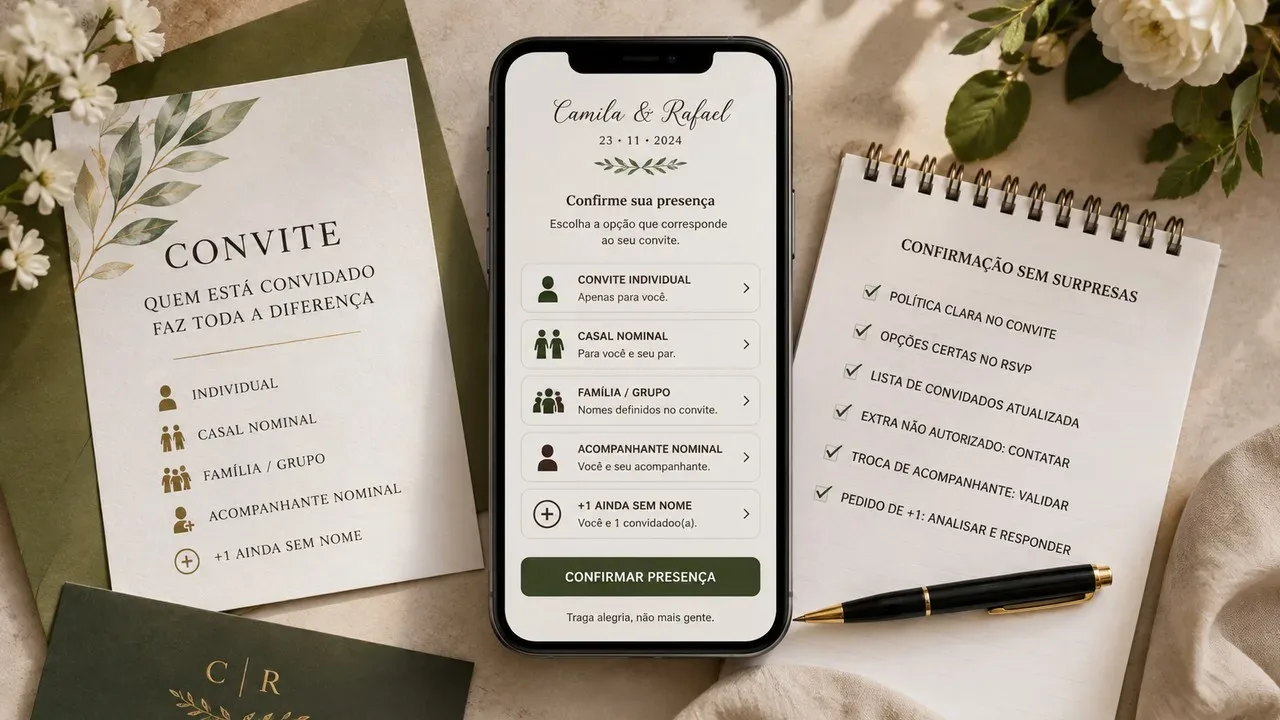
Before starting, also check that couples, families and companions are correctly linked. A couple that appears as two independent records may end up separated by accident. The same goes for parents with young children, a person with a support companion, or any group that must stay together for a practical reason.
Close the board before moving names
The capacity of each table must be known before distribution. Don’t use a generic number just because “round table usually has ten seats”. What matters is the actual capacity defined for that table in the chosen layout, considering the size of the furniture, the assembly, the circulation and what was agreed with the space or supplier.
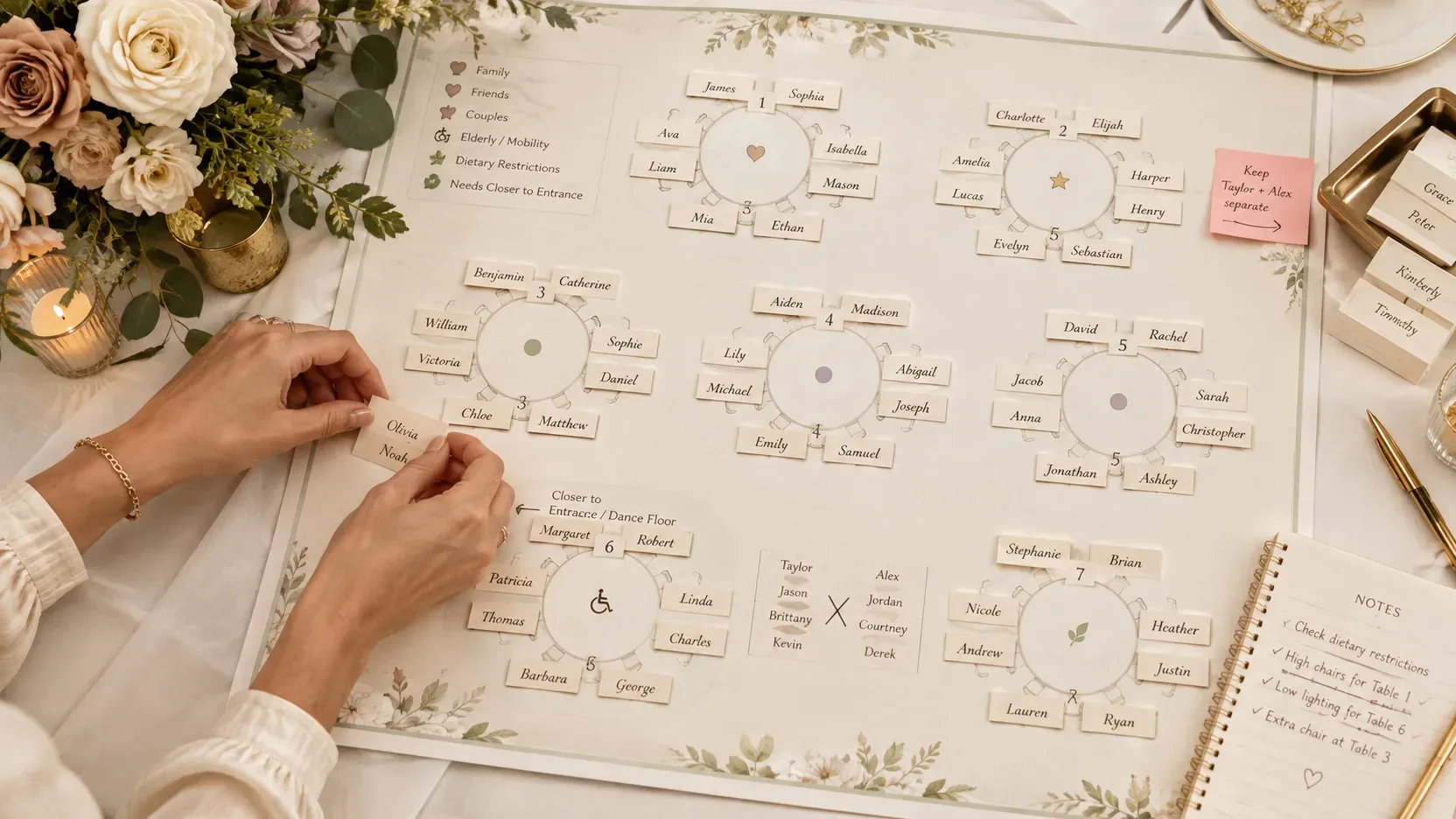
In addition to capacity, record the position of tables. A table near the entrance is not equivalent to a table near the dance floor, the sound, or a narrow passage. For most guests, this will simply be a difference in ambience. For someone with reduced mobility, difficulty moving around, needing a companion or sensitivity to noise, position can be an important restriction.
At this stage, the map doesn't need to have people yet. It needs to have tables identified, the actual capacity of each one and relevant areas of the room. Only then do the names come in.
Transform affinities into groups and restrictions
Affinity helps to form pleasant tables, but it should not be the only rule. The method is more reliable when each person or group receives simple information about bonds and restrictions.
Who should stay together
This includes couples, guardians and children, family members who depend on each other, support companions and any couple or small group whose separation would create an objective problem. This is a hard rule: the group must be allocated as a unit.
Not every social group needs to be rigid. Four close friends may prefer to stay together, but perhaps two of them can move to a neighboring table without prejudice. The difference between obligation and preference prevents the map from getting stuck too soon.
Who shouldn't be together
Known conflicts need to be recorded discreetly and operationally. It is not necessary to document the history of the conflict; just mark that certain people or groups should not share the same table. In more delicate cases, it may make sense to also avoid immediately neighboring tables, depending on the space.
The use of this rule is to prevent filling by affinity or counting by chance placing two incompatible people in the same group.
Who needs to be in a certain zone
The need for access should be treated as a position requirement, not as a last-minute detail. A person may need a simpler route to the table, proximity to an exit, shorter distance to restrooms or more comfortable space to move around with a wheelchair, cane or other support.
The ideal position must be confirmed with the actual layout of the site. The objective is not to create an “elderly table” or separate people by condition, but rather to ensure that the distribution respects concrete needs without removing the person from their social group when this can be avoided.
Allocate cases with less freedom first
After recording the rules, start with the guests with the fewest fitting options. A couple who need to stay together and close to the entrance have fewer possibilities than two friends without restrictions. A family of six is more difficult to move than a single person. A group that cannot share a table with another also reduces the number of possible combinations.
This order avoids the effect of reaching the end with an apparently full table and discovering that the only remaining group doesn't fit or violates a restriction. Hard cases come in first; then, large groups; then the strongest affinities; lastly, guests with greater flexibility.
Don't try to fill all the tables to the limit at the beginning. A small gap distributed throughout the room works as a margin for last minute changes. This doesn't mean wasting seats, but avoiding a configuration so cramped that any additional companions require you to dismantle several tables.
Balance the tables without sacrificing social logic
Tables with exactly the same number of people look organized on paper, but mathematical equality is not the main goal. A table with eight people who know each other and talk well can work better than a table with ten formed just to reach maximum capacity.
Balance must observe three things at the same time: no one exceeds capacity; no group is socially isolated without need; and the difference in occupancy between tables does not create a clear sensation of an “empty” table next to a crowded one. If a table has six people and the others have nine or ten, it's worth reviewing. If the distribution is eight, nine and ten, it may be perfectly adequate, as long as the layout and profile of the groups make sense.
When moving someone to balance a table, double-check the strict rules. A count adjustment cannot separate a couple, break a need for access, or create a conflict that did not exist before.
Assigned table and assigned seat are not the same thing
In the assigned table model, each guest is assigned a table number or name and chooses a chair when they arrive. This format solves most of the distribution problem with less maintenance, because it allows people to fit freely within an already planned group.
In the assigned seating model, each chair is also defined. It's an additional layer of control. It can be useful when there are long tables, places with very different characteristics, plated meals with place identification, the need to keep a companion next to a specific person or conflicts that require distance within the table itself.
The more detailed the map, the higher the revision cost. If the event does not require exact seating, assigning just the table usually preserves organization without turning each confirmation change into a chair reconstruction.
Complete example: before and after applying restrictions
Imagine a reception with 36 confirmed guests and four tables of ten seats. There are six natural groups: eight people from the bride's family; seven from the groom's family; seven friends from college; six friends from work; four godparents organized into two couples; and four guests with no strong ties to a single group.
There are also three strict rules. Helena, from the bride's family, needs simpler access and should be at a table close to the entrance. The two couples of godparents must not be separated. Júlia, from the college group, and Renato, from the work group, should not be at the same table.
First version: fill in by affinity and quantity
A distribution made just by looking at the groups could place the bride's family with one of the groomsmen couples, closing ten places. The groom's family would welcome the other couple of groomsmen and a flexible guest, also numbering ten. The seven college friends would welcome three people from work to complete the third table. The fourth would be with the remaining three people from work and three flexible guests, totaling just six.
The count closes, but problems arise. Júlia and Renato may have been placed together at the third table. The fourth one is much emptier than the others. Helena may have been allocated in a bad position because the access zone was not included in the decision. Furthermore, any new companions would require moving already crowded tables.
Revised version: restrictions first, affinities later
In the second version, the table near the entrance welcomes the eight people from the bride's family, including Helena, and two flexible guests. The groom's family gets one of the groomsmen couples, totaling nine. The seven friends from college stay with the other couple of godparents, also totaling nine. The six friends from work welcome the remaining two flexible guests and close with eight.
Now the four tables have ten, nine, nine and eight people. Júlia and Renato are separated. The godparent couples remain together. Helena is in the right zone. There are still four free seats in the set, distributed across three tables, which provides scope for a late change without dismantling the entire map.
The gain does not come from finding a “perfect” combination. It comes from turning the problem into a sequence of verifiable decisions.
A reusable decision matrix
The matrix can be created in a spreadsheet, application or planning form. For each person or group, record seven pieces of information: group name; number of people; who should stay together; who shouldn't be together; required zone; preferred affinities; and constraint priority.
Priority is the field that organizes the work order. Access rules, dependency, capacity and separation due to conflict come as a high priority. Coexistence preferences come in later. Light affinities and possibilities of meeting new people are a low priority.
Beside the guests, keep a second view of the tables: identification, actual capacity, room area, current occupancy and remaining spaces. The distribution then stops being a collection of loose names and becomes a comparison between group requirements and resources available at the tables.
When a combination is proposed, checking is simple. First check if the group fits. Then, any rule of permanence or separation is violated. Then confirm the zone. Only then use affinity to choose between the options that remain valid.
How to review the map when someone cancels or confirms later
Late changes do not need to trigger a chain reaction. The first question is whether the adjustment can be resolved locally.
When someone cancels, the empty seat can remain empty if the table remains balanced and socially coherent. It is not necessary to move another person just to “close” the count. If the
cancellation leaves someone isolated or dismantles a small group, then it is worth relocating.
When a new companion appears, treat the pair as a unit and first look for a table that has two spaces and is compatible with the rules. If there is only one seat at the appropriate tables, move as few people as possible to make room. Avoid rearranging four tables when a swap between two works.
When an access need changes, the zone takes priority over light affinities. The adjustment must seek a suitable table without separating important links. If the change requires changing another person, prefer someone flexible, without rigid rules regarding position or coexistence.
After any change, perform a new check of capacity, links, conflicts and zones. A revised map is only ready when the change has not created a problem elsewhere.
The final review should look for errors, not just empty spots
Before considering the map complete, check whether any tables exceed the actual capacity and whether the remaining spaces are distributed reasonably. Check that all couples, families or companions marked as inseparable are still together. Confirm that people with social restrictions were not brought together by a late exchange.
Also review the zones. Is anyone who needs easy access in a position compatible with the space? Does the chosen table have adequate circulation in the actual layout? Is there anyone who was isolated from all close ties just because there was one chair left?
Finally, compare the map with the current list of confirmed. The simplest mistake is also one of the most common: perfectly distributing an old version of the list.
The map is easier when list, capacity and changes are in the same flow
The logic works on paper, spreadsheet or software, but gains efficiency when confirmations, companions and tables are updated in the same place. This reduces the chance of reviewing outdated copy and makes the impact of each change more visible.
In Biomi Invite, this approach can be applied using guest and companion data in conjunction with capacity and table formats. The most important thing is to stick to the method rule: first the confirmed list, then hard restrictions, then affinities, and finally balance adjustments.
A good table map is not the one that looks most symmetrical. It's what fits in the real space, respects the relationships that matter and can be corrected without starting from scratch when the wedding approaches.