
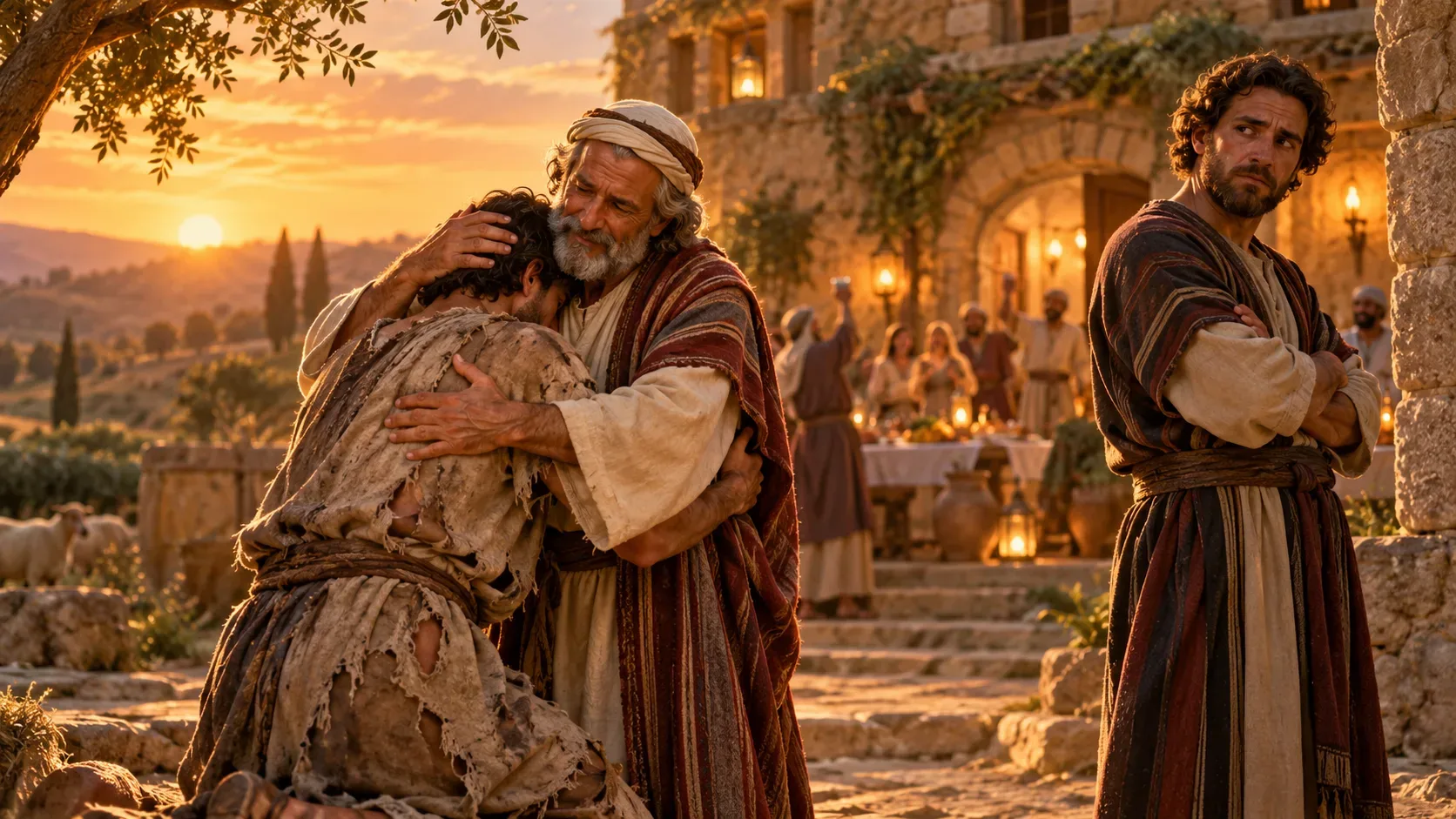
The older brother prevents Luke 15 from being read only as a story about someone who does wrong, repents, and comes home. When he appears, the question also becomes what happens to the person who stayed close to the father but cannot share his joy at the brother's return. The narrative ends without saying whether the older son enters the celebration. That silence turns the ending into a question for the reader: can mercy be accepted when it does not operate as payment for merit?
Before the prodigal son, Luke presents the conflict that drives the parable
Luke 15 opens with tax collectors and sinners drawing near to Jesus while Pharisees and scribes complain that he welcomes sinners and eats with them. Then come the stories of the lost sheep, the lost coin, and finally the father with two sons. This framing matters because the third parable is not only about the son who leaves home. It also places on stage someone who stays nearby, fulfills his duties, and still reacts with indignation when the father celebrates the other's return.
For that reason, calling the passage only the "parable of the prodigal son" can hide part of its construction. The story itself begins by saying that a man had two sons. The younger one occupies the first half; the older one dominates the ending. The father has to go out to meet both.
A three-scene reading: departure, celebration, and an open door
1. The younger son breaks away, loses everything, and returns
The younger son asks for his share of the property, leaves for a distant country, and dissipates what he received. After loss and hunger, he decides to return. He prepares a confession that is also an attempt to redefine his place in the household: he no longer considers himself worthy to be called a son.
The father, however, runs to meet him, embraces him, and organizes a celebration. At the narrative level, the return is not treated as the simple readmission of a worker. The feast communicates restoration of the family bond: the one who was lost has been found.
2. The older son hears the celebration and refuses to enter
At this point the parable shifts its focus. The older son comes back from the field, hears music and dancing, asks a servant what happened, and learns that his brother has returned. His reaction is not neutrality or mere surprise: he becomes angry and refuses to go in.
This refusal creates a second kind of outside. Earlier, the younger son was far from the house by his own choice. Now the older son stands near the house but remains outside because of his indignation. Distance is no longer geographic; it has become relational.
3. The father goes out again, this time to the older son
The father does not send a servant to force the older son inside. He goes out himself and pleads with him. The son's reply makes the conflict clear: he describes his years of obedience as service, compares what he received with the banquet given to his brother, and refers to the younger man as "this son of yours," not as a brother.
The father answers by restoring two relationships to the center. First, he reaffirms closeness: the older son is always with him and shares in all that is his. Then he restores the fraternal bond in his language: the person the older son called "your son" is called by the father "your brother." The joy is therefore not explained as a reward for the younger son's previous behavior, but as a response to someone once considered lost having returned.
The brothers' words reveal two different ways of measuring relationship
| Element | Younger son | Older son | What the contrast adds |
|---|---|---|---|
| How he sees his position | He returns thinking he has lost the place of a son and could be treated as a worker. | He says he has served for years and never disobeyed. | Both speak from a logic of conditions and merit, although in opposite directions. |
| Main problem | Open rupture, waste of property, and departure. | Resentment, comparison, and refusal to share the father's joy. | The parable expands what it can mean to be lost: a person can be far from the house or near it without sharing the father's heart. |
| How he speaks of the other brother | The text gives no verbal confrontation with the older brother. | He refers to the younger one as "this son of yours." | His wording avoids "brother"; the father restores that word by saying "your brother." |
| What he expects | He expects demotion after guilt. | He expects recognition proportional to the service he has rendered. | One expects punishment, the other reward. The father answers both from the family bond. |
| Where his scene ends | Inside the celebration prepared by the father. | Outside, hearing the father's invitation. | The older son's narrative outcome remains open and directly involves the reader. |
An important detail: the older brother's accusation goes beyond what the narrator had said
In the first part of the parable, the narrator says that the younger son squandered the property in a life of dissipation. When the older brother protests, he adds the accusation that the younger man consumed the property with prostitutes. Up to that point, the story had not presented this detail as information from the narrator.
This difference does not allow us to state with certainty why the older brother chooses that accusation, but it shows how heavily judgment shapes his speech. He is not merely reporting his brother's return. He constructs a moral contrast between his own service and the other's conduct, which makes the collision between his accounting of merit and the father's decision to celebrate restored relationship even clearer.
What the open ending does to the reader
Luke ends the parable with the father's words. There is no next verse telling us whether the older son entered, stayed outside, or replied. This is decisive for the narrative effect. The story does not resolve for us the reaction of the person who considers himself faithful and unfairly treated.
In his General Audience of May 11, 2016, Pope Francis draws attention to this suspended ending and says that the sons can accept or reject the father's joy. In the catechesis published in April 2025, the interpretation returns to the fact that the father also goes out to meet the older son and leaves the door open. These are explicitly Catholic interpretations of the passage, not statements made by Luke's narrator.
That distinction is useful. The biblical text supplies the narrative elements: the older brother becomes angry, refuses to enter, receives a visit from the father, and hears an invitation grounded in the family bond. The Catholic catechesis interprets these elements as an image of someone who can remain outwardly close and yet be inwardly distant, and it connects the older son with listeners who judge the sinners welcomed by Jesus.
Biblical narrative and Catholic commentary: what belongs to each level
| Point | What Luke 15 presents | Catholic interpretation cited |
|---|---|---|
| Audience and context | Jesus responds in a setting where Pharisees and scribes complain about his table fellowship with sinners. | The 2025 catechesis connects the older son especially with people who judge others and do not recognize their own inner distance. |
| The older son's condition | He stayed at home, works, becomes angry at the celebration, and does not want to enter. | Francis says that he too needs to discover the father's mercy. |
| The father's action | The father goes out and pleads with him, recalling their closeness and calling the returnee "your brother." | The Catholic reading sees in this initiative a father who also seeks the resentful son and does not close the door. |
| The ending | The text does not report the older son's decision. | The 2016 catechesis treats the suspended ending as an invitation for the listener to ask whether he or she will enter the joy of mercy and fraternity. |
So what does the older brother add to the parable?
He adds a second problem to the theme of return. The question is no longer only "will the father receive the one who came back?" It also becomes "will the one who stayed accept the other's return?" This blocks a simplified reading in which there is only one obvious sinner and one correct character observing from the side.
The older brother also shows that physical closeness, obedience, and work do not by themselves guarantee relational communion. His words reveal resentment, comparison, and difficulty recognizing the other as a brother. At the same time, the father does not discard him. He goes to him, reaffirms his place as a son, and invites him to participate.
Finally, the absence of an answer ends the parable without ending the conflict. The story leaves the door open literally for the character and literarily for the listener. The reader is not given the older brother's final decision because the narrative presses each listener to consider his or her own reaction to mercy that restores someone without turning welcome into a prize for performance.