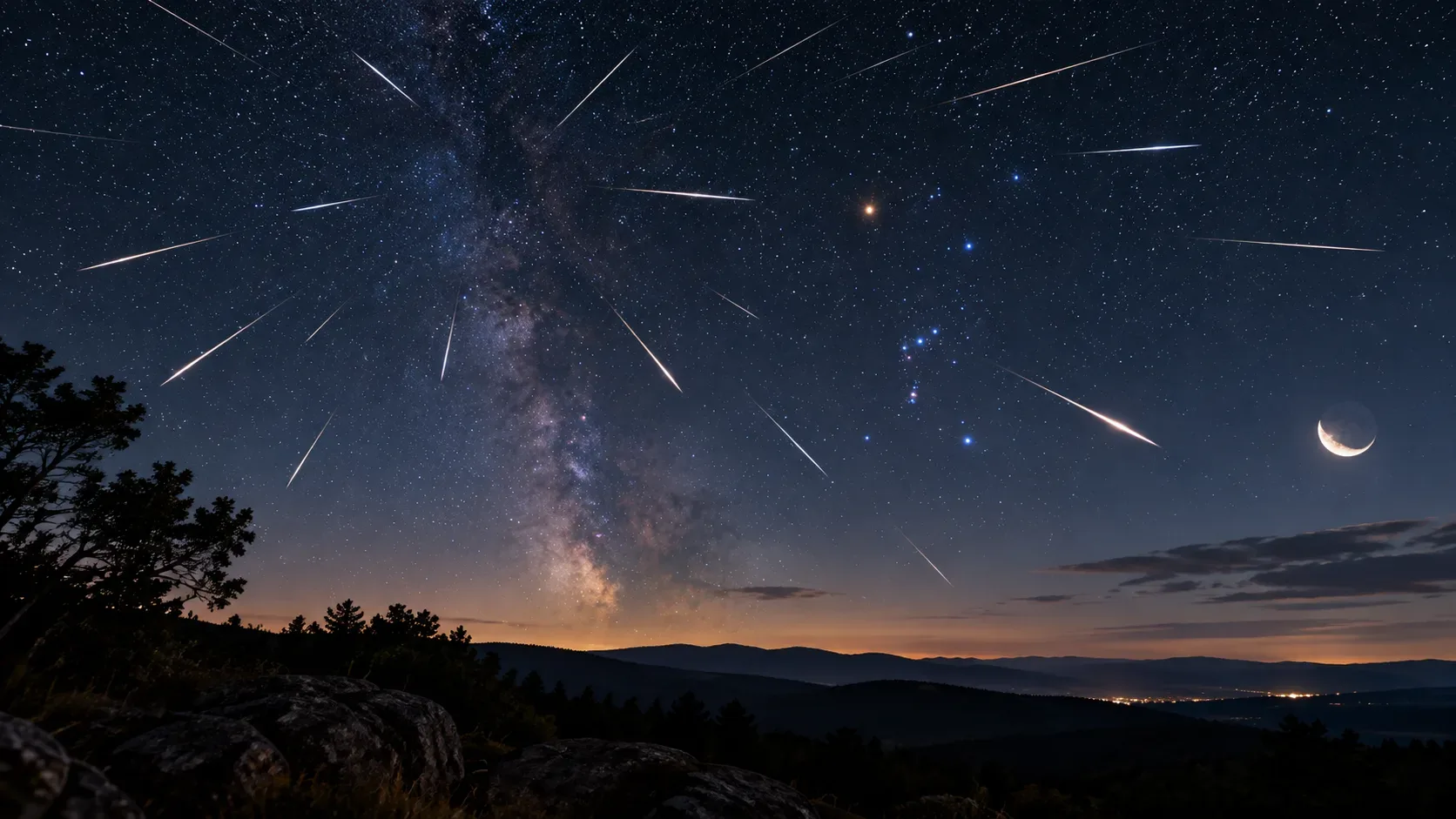
The Orionid meteor shower will reach its peak night on October 21 to 22, 2026, according to NASA's calendar. The shower is active from October 2 to November 7, but the maximum night offers the best opportunity to try to see more meteors. NASA lists about 10 to 20 meteors per hour under dark skies. That figure is a reference for favorable conditions, not a promise of what every observer will see.
When will the Orionids peak in 2026?
| Item | 2026 information |
|---|---|
| Active period | October 2 to November 7 |
| Peak night | October 21 to 22 |
| Most useful viewing window | After midnight until dawn |
| Rate listed under dark skies | About 10 to 20 meteors per hour |
| Radiant | Near Orion, just north of Betelgeuse |
| Parent body | Comet 1P/Halley |
| Meteor speed | About 66 km/s |
NASA's page identifies the peak night but does not give one specific clock time as the exact maximum. For practical planning, the agency recommends watching the Orionids during the hours after midnight. This applies in both the Northern and Southern hemispheres.
Will the Moon interfere with viewing in 2026?
Yes. Moonlight is expected to be an important factor. The American Meteor Society calendar lists a waxing gibbous Moon on the night of October 21 to 22, 2026, at about 74% illumination, and warns of significant interference while the Moon is above the horizon.
In practice, moonlight brightens the sky and can wash out fainter meteors. Brighter streaks may still be visible, but the actual count can be lower than the potential under a truly dark sky. For that reason, the 10 to 20 meteors per hour reference should not be treated as a visibility guarantee.
How to watch the Orionids
- Choose a dark, safe location. The farther you are from city lighting and streetlights, the better the chance of detecting faint meteors.
- Find a place with a wide view of the sky. Trees, buildings, and mountains can block part of your field of view.
- Start after midnight. NASA recommends the hours after midnight and notes that viewing can continue until dawn.
- Give your eyes time to adapt. NASA says dark adaptation takes less than 30 minutes. Limiting exposure to bright screens helps preserve that adaptation.
- Use the naked eye and scan a broad area. For a meteor shower, the goal is to see as much sky as possible rather than magnify one point.
- Be patient. Meteors appear irregularly. Several minutes without a streak do not mean the shower is over.
Where should you look?
The Orionids' radiant lies in the region of the constellation Orion, just north of the bright star Betelgeuse. The radiant is the perspective point from which the meteors appear to originate, but it is not the physical source of the particles.
You do not need to stare at Orion. NASA recommends looking about 45 to 90 degrees away from the radiant, where meteor trails tend to look longer. For observers in the Southern Hemisphere, the agency's practical orientation is to lie on your back with your feet facing roughly northeast and take in as much of the sky as possible.
What does 10 to 20 meteors per hour mean?
NASA's estimate applies to observation under dark skies. The number actually seen by one person depends on several factors, including moonlight, light pollution, clouds, atmospheric transparency, blocked horizons, observing time, and the radiant's position in the sky.
A short session in an urban area may therefore produce only a few meteors even near the peak. The 10 to 20 per hour figure is a reference for shower activity in favorable conditions, not a minimum count.
Why do the Orionids happen?
The Orionids are produced by particles left behind by comet 1P/Halley. When Earth crosses the region of the orbit where this material is spread out, small fragments enter the atmosphere at high speed and create the luminous streaks seen as meteors.
NASA lists a speed of about 66 km/s for Orionid meteors. Their high velocity can produce glowing trains that persist for several seconds and, occasionally, especially bright meteors.
What to expect on October 21 to 22
The best approach is to treat the peak night as a viewing window, not as a guaranteed show. In 2026, the lunar phase reduces sky quality during part of the night. Choosing a dark site, staying outside for a longer period, and observing after midnight improve the chance of making use of the more favorable intervals.
If clouds, strong local lighting, or a bright Moon dominate the sky, visibility can fall sharply. Even in good conditions, meteor activity is not uniform. Results vary by location and by time interval.