
The problem is not having repetitive activities. The problem is turning every repetition into a task with a daily due date. When this happens, the “Today” list stops showing what really needs to be resolved and starts to mix commitments, habits, routines and small actions that do not really generate pending issues.
The difference between a recurring task, a habit and a routine with a checklist does not need to be philosophical. It can be operational: what happens if you don't do it today, what result needs to exist at the end and what you want to track over time. With these questions, it becomes easier to choose where to record each activity and prevent planning from becoming a source of noise.
The difference that solves most of the doubts
A recurring task represents an obligation or deliverable that returns at a known frequency. Each occurrence has a verifiable result: the report was sent, the bill was paid, the backup was checked, the plant was watered, the weekly review was completed. In task applications, recurrence logic typically advances the task to the next occurrence after completion; Different tools may handle delays and future dates differently.
A habit is different because the main goal is usually to increase consistency and, with repetition in a stable context, make a behavior more automatic. In this case, missing an opportunity may be undesirable, but it does not necessarily create a “debt” that needs to be paid off the next day. In a classic study of habit formation, participants repeated everyday behaviors in the same context for 12 weeks, and missing a single opportunity did not materially affect the habit formation process.
A checklist routine appears when there is a process made up of several steps that make sense together. Instead of creating five independent daily tasks, it may be better to have a single activity, such as “Close the day”, and within it check pending issues, organize files, record what is left for tomorrow and close the necessary systems.
There is also a fourth option: not registering. An action that already happens naturally, has no real consequences when forgotten and does not need to be measured may not deserve space in your task system.
The decision tree for choosing the right format
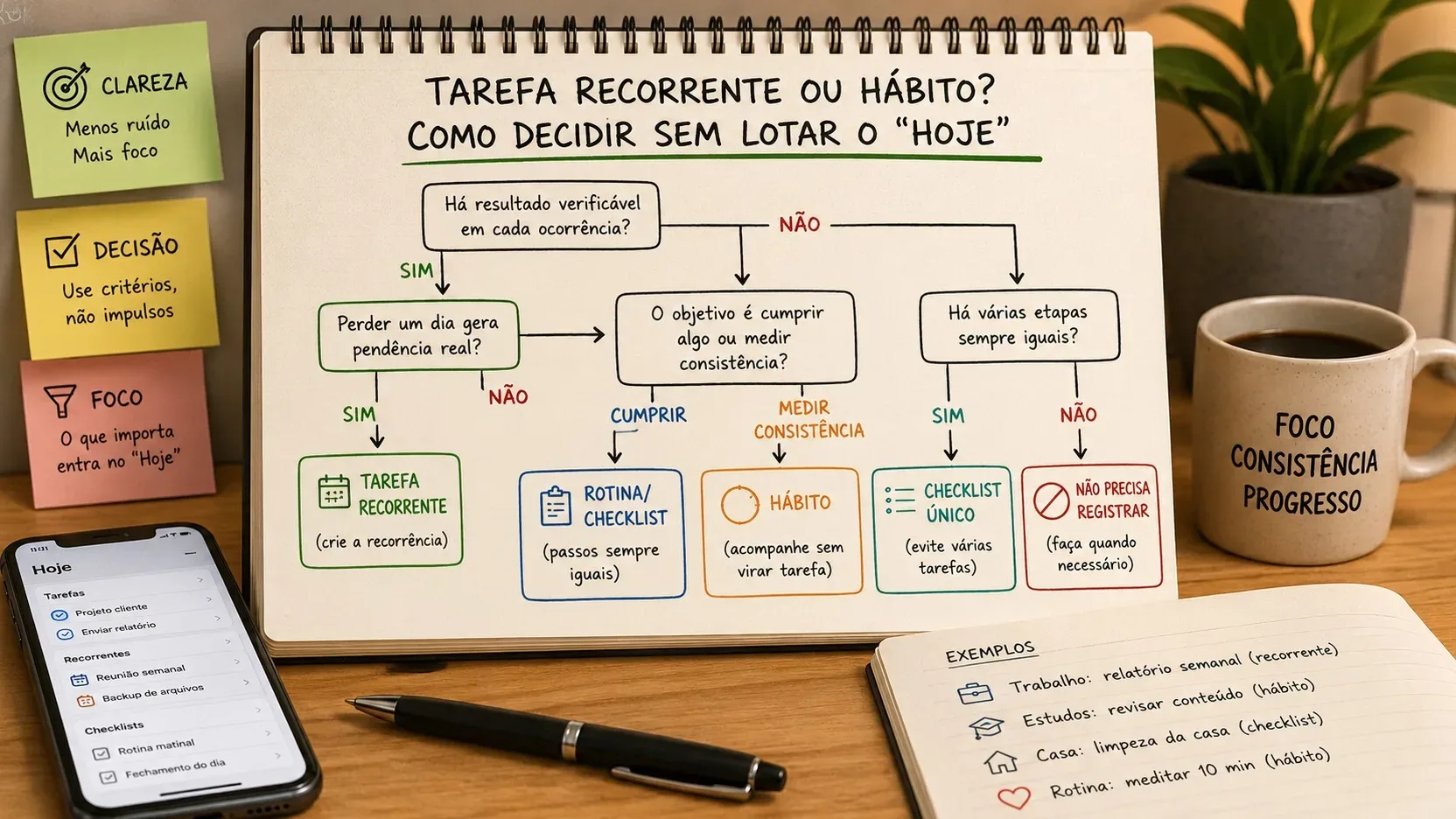
The best way to avoid a congested list is to decide before creating the recurrence. Use the questions below as a sequence. These are not universal categories, but a practical method for separating types of repetition according to the effect they have on your routine.
Is there a verifiable outcome and obligation in each occurrence?
If the answer is yes, the activity tends to work better as a recurring task. “Send report every Friday”, “pay rent on the 10th”, “make monthly backup” and “review expenses on the last working day of the month” have one characteristic in common: each occurrence ends with something that can be considered done or not done.
Here, the date has a real function. It doesn't just exist to remind you of desirable behavior; it exists because that commitment comes back and needs to be completed in that cycle.
Missing a day generates a real pending issue?
This question separates obligation from consistency. If you have not paid a bill, the obligation continues to exist. If you haven't submitted a report, there is still something pending. If you didn't have the scheduled inspection, it probably needs to be rescheduled. This points to recurring task.
Now think about “reading for twenty minutes”, “practicing vocabulary” or “stretching in the morning”. Missing a session may reduce your consistency, but it doesn't mean that tomorrow you need to read forty minutes, study two sessions, or do two stretches to pay off an operational debt. This points more to habit.
Is the objective to fulfill an occurrence or measure consistency?
When the focus is on completing a delivery, use task. When the focus is on observing frequency, sequence or regularity, the habit format is usually more appropriate. This distinction also helps when the same activity could fit into both models.
“Studying English” can be a habit if the objective is to maintain frequent contact with the language. “Complete unit 4 by Friday” is a task with a result and a deadline. The behavior is similar, but the function within the planning is different.
Are there several steps that almost always happen together?
If so, consider a routine or main task with a checklist. The advantage is to reduce the number of items competing for your attention without losing control of the process.
Instead of placing “save documents”, “update spreadsheet”, “separate pending issues” and “prepare tomorrow’s agenda” as four daily tasks, you can have a single closing routine. The “Today” list shows an obligation; the checklist contains the details necessary to execute it well.
Does recording this action change any decisions?
If the answer is no, it may not even need to enter the system. A good task manager is not an inventory of everything a person does during the day. It serves to remember, prioritize, organize and track what really benefits from recording.
When recurring task is the right choice
Recurring tasks work best when there is repetition with responsibility. The most important element is not frequency, but rather the existence of an occurrence that needs to be closed.
At work, “send performance report every Monday” is a good recurrence because each week generates its own delivery. “Review contracts on the first business day of
month” is also a recurrence if there is a concrete review that needs to happen each cycle.
In studies, “delivering weekly exercise of the subject” is a recurring task when the activity actually repeats itself. “Reviewing material for twenty minutes” can be a habit if the main objective is to maintain consistency, without turning a lost day into an accumulated delay.
At home, “paying a condo fee”, “separating recyclable material on Wednesday” or “changing a filter every certain period” have verifiable results. For this type of activity, recurrence removes memory from the obligation to recreate the task every time it comes back.
It is also worth distinguishing calendar recurrences and completion-based recurrences. In some tools, an activity can always return on a fixed date; In other settings, the next deadline may be calculated from the time you completed the previous occurrence. The first logic makes sense for commitments tied to the calendar. The second can be useful in maintenance or revisions whose next cycle depends on when the last execution actually took place.
When a habit shouldn’t dominate the “Today” list
A habit may appear as a daily reminder, but this does not mean that it needs to occupy the same priority layer as tasks with a deadline. When all habits are included in the “Today” list, activities such as reading, walking, reviewing vocabulary, organizing the table and drinking water can compete for visual space with paying a bill, sending a document or completing a work delivery.
The effect is a loss of signal. The list gets longer, but not necessarily more useful. Furthermore, a delayed habit can seem like an operational issue, when what really matters is regularity over time.
If the tool you use has habit tracking, completion history or a separate area for routines, choose this layer when the goal is consistency. If you don't have one, you can still represent the habit as a recurrence, but it's worth visually separating these items from the commitments that generate real delay.
A simple rule helps: if failing today does not create mandatory work for tomorrow, avoid treating the activity as if it were an accumulated debt.
When a checklist routine is better than multiple tasks
Checklists are especially useful for repetitive processes with small, predictable steps. The goal is not to remember each micro-action as if it were an independent commitment, but to ensure that the entire process is executed without forgetting steps.
At work, a closing routine can include updating records, organizing documents, reviewing pending issues and preparing for the next day. In studies, a review session can involve opening the material, answering questions, correcting errors and recording points that need to be revisited later. At home, weekly cleaning can bring together rooms and steps into a single activity.
This grouping avoids a common mistake: turning a ten-minute process into six different cards in the daily list. When all steps belong to the same intention and are almost always done together, a single checklist item tends to better represent the actual work.
The same reasoning applies to events that do not need to be recurring. A trip, a test or moving house can have a unique checklist, even without repetition. The checklist organizes steps; recurrence defines whether the appointment should return automatically.
Why daily recurrence generates so much noise
Daily recurrence is easy to create and difficult to perceive as a problem. At first, each activity seems small. After a few weeks, the “Today” list may open with ten or fifteen items before you even record that day's specific tasks.
This volume produces three distortions. The first is visual: important commitments are mixed with optional behaviors. The second is emotional: everything that has not been marked as completed feels like failure or delay.. The third is operational: tasks that are actually due no longer attract attention because the list is already full of recurring items.
The goal should not be to reduce the list for aesthetics. It must be recovering the meaning of what appears in it. If “Today” shows an activity, you need to quickly understand whether it is an obligation, an opportunity to maintain consistency, or a multi-step routine.
Four examples to test the logic
Work: weekly report
There is a verifiable delivery, there is a clear frequency and missing the date creates a real pending issue. The best classification is recurring task. If the report always requires the same steps, these steps can be contained within a checklist of the task itself, rather than appearing as several separate recurrences.
Studies: review content for twenty minutes
If the objective is to maintain frequent contact with the material and maintain consistency, treat it as a habit. If there's a test and you need to complete specific chapters by set dates, make those dues into separate assignments. Habit sustains practice; tasks organize concrete results.
House: weekly cleaning
If cleaning is a process with recurring steps, use a routine or a weekly task with a checklist. Creating a recurrence for each room can be useful when the frequencies really are different, but it tends to generate noise when everything happens in the same block of time.
Personal routine: morning preparation
If you always perform a similar sequence, a checklist routine may work better than several daily tasks. If there is a behavior within it that you
Whether you measure it separately, such as reading or exercise, this behavior can be monitored as a habit while the routine continues as a single operating block.
Audit your “Today” list
Open today's list and note each recurring item. For each, ask whether there is a verifiable result, whether a failure creates a real backlog, whether the goal is to complete or just maintain consistency, and whether multiple actions belong to the same process.
If a daily task does not pass these criteria, change its representation. It can become a habit, get into a routine with a checklist, miss the daily date or even leave the system. The gain isn't just a cleaner screen. It's a list where maturity means something again.
Also observe the behavior of delayed recurrences in the tool you use. Different managers can reschedule the next occurrence with different rules, and this affects the way an issue appears after a delay. Before creating dozens of recurring tasks, it's worth understanding whether the tool maintains fixed dates, moves forward from completion, or skips past occurrences.
How to apply this logic to Biomi Day
In Biomi Day, the combination of recurring tasks and checklist per task allows you to separate what needs to be returned automatically from what just needs several steps. Recurrence makes more sense at the level of the obligation that actually expires; the checklist can concentrate the steps that belong to the same routine.
This avoids using a recurrence for each micro-action and helps preserve the daily list for what really needs attention that day. Habits aimed at consistency can be treated more lightly, without turning every lost opportunity into an accumulated to-do.
The final rule is simple: record the function, not just the frequency
Two activities can happen every day and still deserve different formats. One may be an obligation that returns, another a behavior that you want to consolidate and another a routine with several steps. Frequency alone does not decide.
When each repetition receives the right format, the “Today” list stops being a deposit of intentions and returns to fulfilling its role: showing what deserves action now. Recurrence takes care of recurring obligations, habit measures consistency, the checklist organizes processes and the rest can simply be left off the list.